

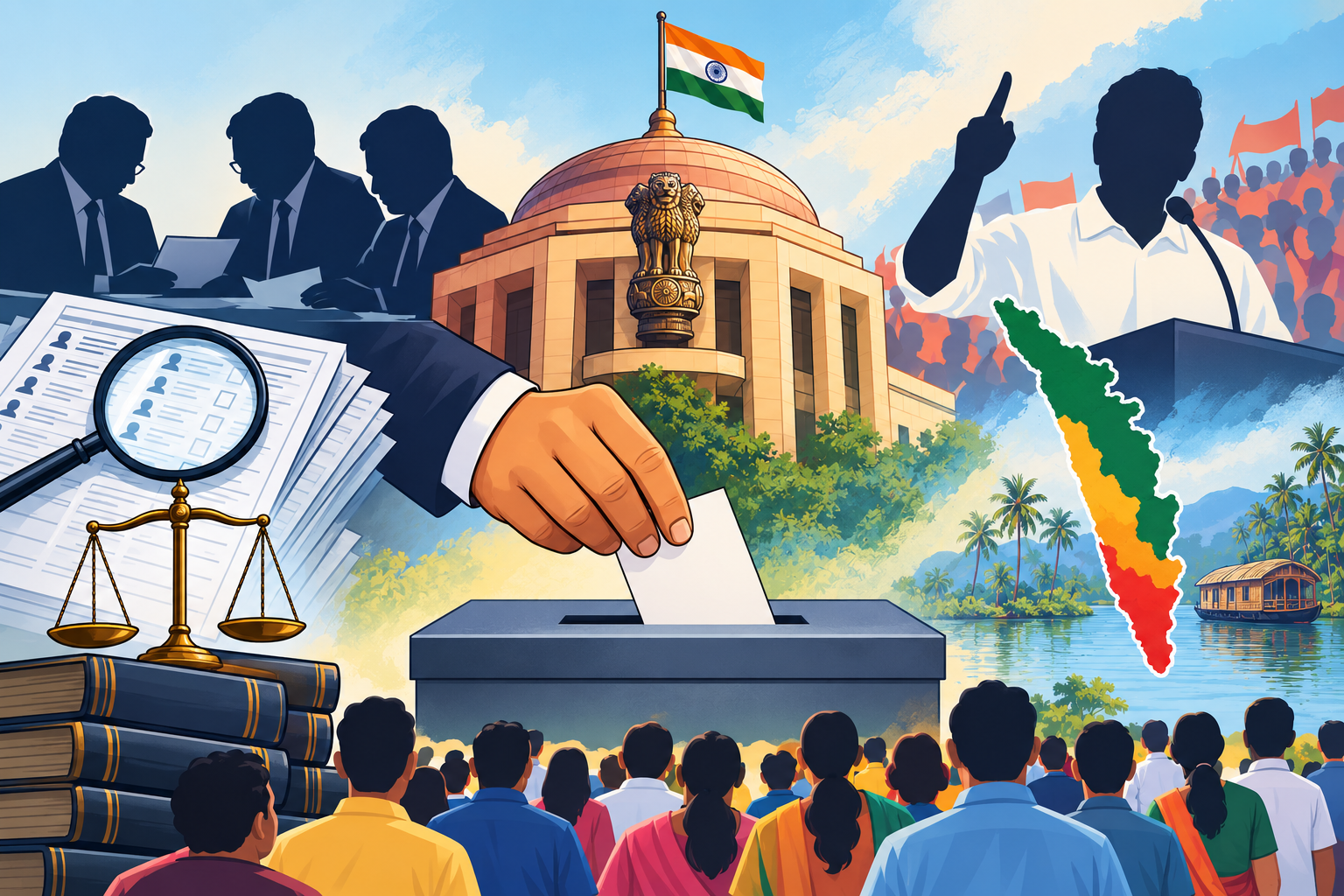
The controversy surrounding Chief Election Commissioner Shri Gyanesh Kumar and the Election Commission of India has taken a serious political turn following reports that two Election Commissioners recorded objections on several occasions regarding decisions connected with the Special Intensive Revision (SIR) of electoral rolls.
The concerns raised by Election Commissioners Shri Sukhbir Singh Sandhu and Shri Vivek Joshi certainly deserve examination. According to The Indian Express, the two Commissioners recorded objections on at least 14 occasions over a period of ten months, concerning matters including voter registration, deletion and restoration of names, appeals and access to electoral-roll systems.
But there is an equally important principle that must not be forgotten:
An objection within an institution is not, by itself, proof of electoral manipulation.
The Election Commission has stated that the reported internal notes do exist, but has characterised them as part of the normal process of internal discussion, feedback and administrative decision-making. More importantly, the Commission has maintained that the final decisions of the three-member Commission were unanimous.
Therefore, until concrete evidence establishes otherwise, it would be unfair and premature to conclude that the CEC personally manipulated elections or deliberately deprived citizens of their voting rights.
The electoral record also needs to be considered.
If the argument is that the Election Commission systematically manipulated elections to favour the BJP, the actual electoral record deserves careful examination.
In the 2024 Lok Sabha election, the BJP won 240 seats, down from the 303 seats it had won in 2019. It therefore lost its previous single-party majority and had to rely on its NDA allies to form the government.
Even more strikingly, the BJP lost the Faizabad Lok Sabha constituency, which includes Ayodhya, despite the Ram Temple being one of the central political issues associated with the BJP’s national campaign.
The Kerala example is particularly relevant
The 2026 Kerala Assembly election provides another important example.
The Congress-led UDF won 102 of the 140 Assembly seats and returned to power, while the LDF was defeated after two consecutive terms. The BJP also won three seats.
This is significant in the present debate because the same SIR process that is now being portrayed in some political speeches as an instrument of “vote theft” was implemented in Kerala before the Assembly election.
There is an additional political point that deserves attention.
Senior Congress leader Ramesh Chennithala, who is now the Home Minister of Kerala, was reported to have praised the SIR process after the UDF’s victory.
This creates a legitimate question for public debate:
If SIR itself constitutes “vote theft”, how should one interpret the overwhelming victory of the Congress-led UDF in Kerala under the same electoral system?
That question deserves an answer based on evidence rather than political rhetoric.
Rahul Gandhi’s allegations need evidence.
Rahul Gandhi has gone considerably beyond questioning the Election Commission’s procedures. He has alleged “vote chori” and described the alleged conduct as a direct attack on the Constitution, going as far as accusing the BJP, RSS and the Election Commission of “treason.”
These are extremely serious allegations.
But serious allegations require serious evidence.
If there has been systematic manipulation of electoral rolls or elections, the appropriate response is to produce the evidence: identify the constituencies, identify the voters allegedly removed or illegally added, establish who authorised the changes, demonstrate how the alleged manipulation affected the result, and place the documentary and technical evidence before the appropriate constitutional or judicial authorities.
A political allegation cannot automatically become an established fact simply because it is repeated with confidence.
Electoral results need to be considered
The BJP has lost Lok Sabha seats. It lost Ayodhya. State governments have changed. The Congress-led UDF won 102 seats in Kerala in 2026.
These are established electoral outcomes and should form part of any serious discussion about allegations of systematic electoral manipulation.
Constitutional institutions cannot be condemned on the basis of allegations alone.
There is, at present, a controversy involving internal objections within the Election Commission. There are legitimate questions about procedure and transparency. But that is different from proof that Chief Election Commissioner Gyanesh Kumar personally manipulated elections or engineered “vote theft.”
Until such evidence is established, the correct democratic position is to demand investigation, transparency and accountability — not predetermined guilt.
Indian democracy ultimately belongs to the voter.
The answer to allegations concerning elections should therefore be more evidence, more transparency and stronger institutional scrutiny — not the replacement of evidence by political rhetoric.
Democracy is protected not merely by questioning institutions, but also by respecting evidence before declaring an institution guilty.
Harikumar Menon
Vice President
Democratic Social Justice Party (DSJP)
State of Keralam