

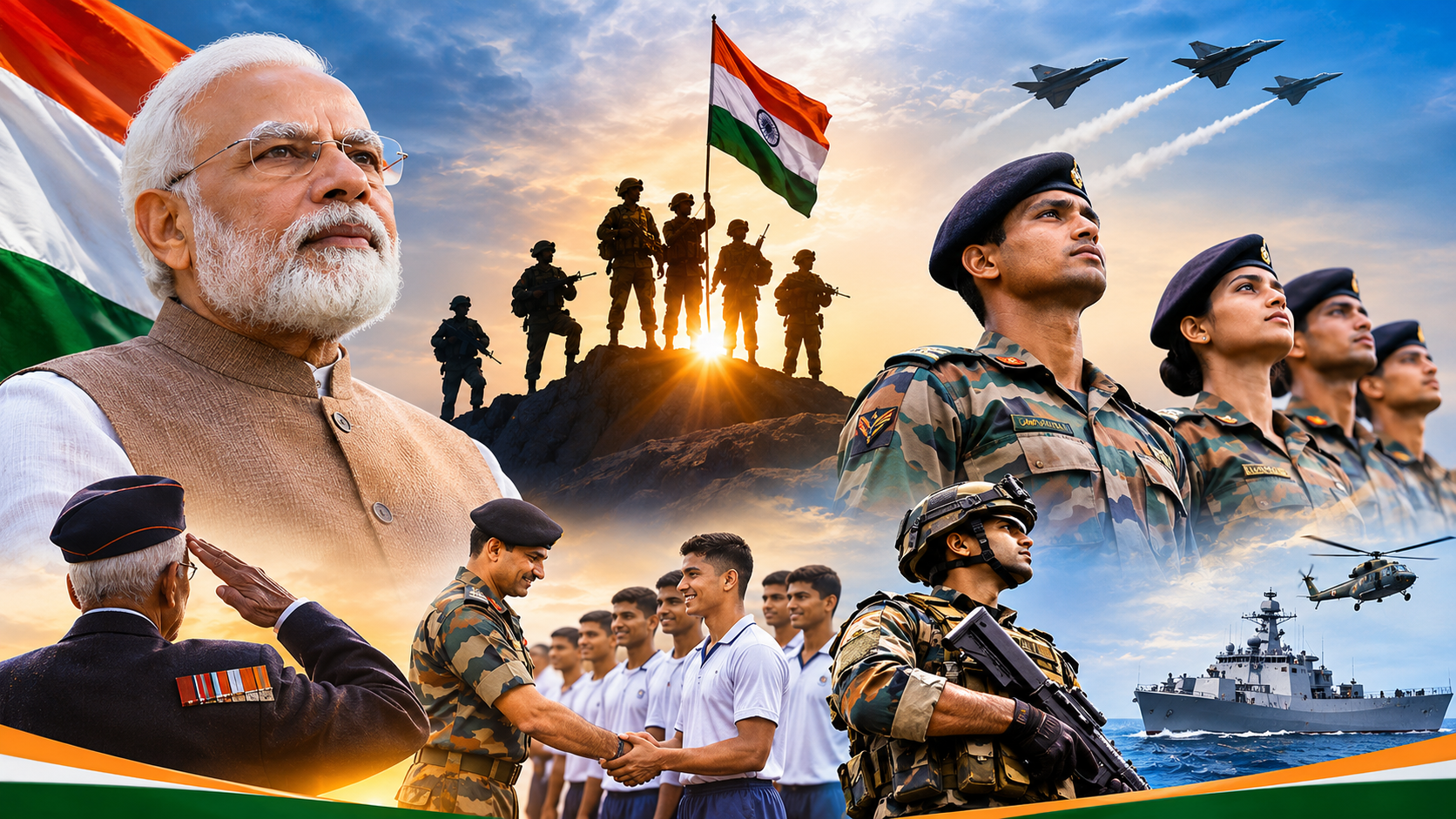
From One Rank One Pension to Agniveer — Strengthening the Armed Forces and Recognising the Sacrifices of Our Soldiers
India’s Armed Forces have always been the pride of the nation. The courage, dedication and sacrifices of our soldiers deserve not merely public appreciation but meaningful policies that protect their welfare, recognise their service and secure their future.
Under the leadership of Prime Minister Narendra Modi, the Central Government has introduced several important initiatives concerning the welfare of serving soldiers, ex-servicemen and the modernisation of the Armed Forces.
These reforms represent different dimensions of military welfare and the enhancement of India’s defence capabilities.
- One Rank One Pension (OROP): Fulfilling a Long-Standing Demand
One of the most significant decisions concerning the welfare of ex-servicemen was the implementation of the One Rank One Pension scheme.
For nearly four decades, retired defence personnel had been demanding equal pension for personnel retiring in the same rank with the same length of service, irrespective of their retirement date.
The Modi Government announced the scheme in September 2015 and issued the implementation order on 7 November 2015, with retrospective effect from 1 July 2014.
The scheme also covered family pensioners, including war widows and disabled pensioners. Pension revision every five years was incorporated into the framework.
The subsequent revisions, including the revision effective from July 2024, have continued this initiative.
OROP addressed an important financial concern of military veterans and their families. It recognised that the relationship between the nation and its soldiers does not end when they retire.
- SPARSH: Modernising Defence Pension Administration
The introduction of SPARSH (System for Pension Administration – Raksha) brought digital transformation to defence pension administration.
It provides an integrated online platform for pension processing, sanction and disbursement, enabling defence pensioners to access pension-related services more conveniently.
This initiative seeks to improve transparency, efficiency and accountability in pension administration.
- Agnipath: A New Approach to Military Recruitment
Introduced in June 2022, the Agnipath Scheme represents a major change in the recruitment structure of the Indian Armed Forces.
Its primary objective is to create a younger, fitter, more agile and technologically capable military.
The scheme provides an opportunity for young Indians to serve the nation as Agniveers for an initial period of four years, including training.
Military service provides exposure to discipline, leadership, teamwork, physical fitness, modern equipment and advanced technology.
Up to 25 per cent of each batch can be selected for regular service, based on merit and organisational requirements.
Those completing their engagement receive the Seva Nidhi package and acquire valuable military training and experience.
- The Landmark Cabinet Decision of 4 November 2026
The latest decision by the Union Cabinet, chaired by Prime Minister Narendra Modi, has introduced a significant additional opportunity for Agniveers.
Following an assessment of four years of implementation and feedback from the Defence Forces, the Cabinet approved an additional engagement period of two years for the remaining 75 per cent of Agniveers who are not initially selected for regular service.
After completing this additional engagement, they will be offered enrolment as regular soldiers, subject to their willingness and fulfilment of the prescribed selection criteria.
The additional engagement will carry higher remuneration, an enhanced Seva Nidhi package and seniority benefits.
This decision creates a further pathway towards regular military service and addresses an important concern regarding the career prospects of Agniveers.
It also demonstrates the importance of reviewing and improving policies based on practical experience and institutional feedback.
- Opportunities After Military Service
The Government has also introduced employment-related measures for former Agniveers.
These include reservation provisions in certain Central Armed Police Forces and other government employment opportunities.
The objective is to make productive use of the discipline, skills, training and experience acquired during military service.
A trained Agniveer can contribute to several sectors, including security, logistics, technology, disaster management and administration.
The military experience of these young citizens can therefore benefit society even beyond their period of service.
- Recognising the Soldier Beyond Retirement
The larger significance of these reforms lies in recognising that the welfare of military personnel must extend throughout their lives.
OROP addresses pension equality.
SPARSH seeks to modernise pension administration.
Agnipath reforms the recruitment framework, while the latest Cabinet decision expands the engagement opportunities available to Agniveers.
These initiatives address different needs, but they share an important policy objective: improving the institutional framework for serving personnel and veterans.
Conclusion:
Respecting the Past, Strengthening the Present and Preparing for the Future
The story of India’s defence reforms under the Narendra Modi Government encompasses both veterans’ welfare and the modernisation of military recruitment.
The implementation of OROP, effective from July 2014, addressed a demand that had remained unresolved for decades.
The subsequent digitalisation of pension administration and the introduction of Agnipath represent further changes in the way the country manages military service and personnel welfare.
The latest Cabinet decision of November 2026 adds another dimension by providing an extended engagement opportunity and a pathway towards regular service for eligible Agniveers.
Every major reform requires continuous evaluation. Issues concerning pension parity, the welfare of veterans, the career prospects of young recruits and the operational requirements of the Armed Forces must receive sustained attention.
Our soldiers defend the nation’s borders, protect its sovereignty and stand ready to make the supreme sacrifice. Their contribution deserves lasting recognition through effective policies and institutional support.
A nation that respects its veterans, supports its serving soldiers and creates meaningful opportunities for its young defenders is investing in its own security and future. Narendra Modi government has been doing the same.
JAI HIND
VANDE MAATHARAM
Harikumar Menon
Vice President
Democratic Social Justice Party (DSJP)