

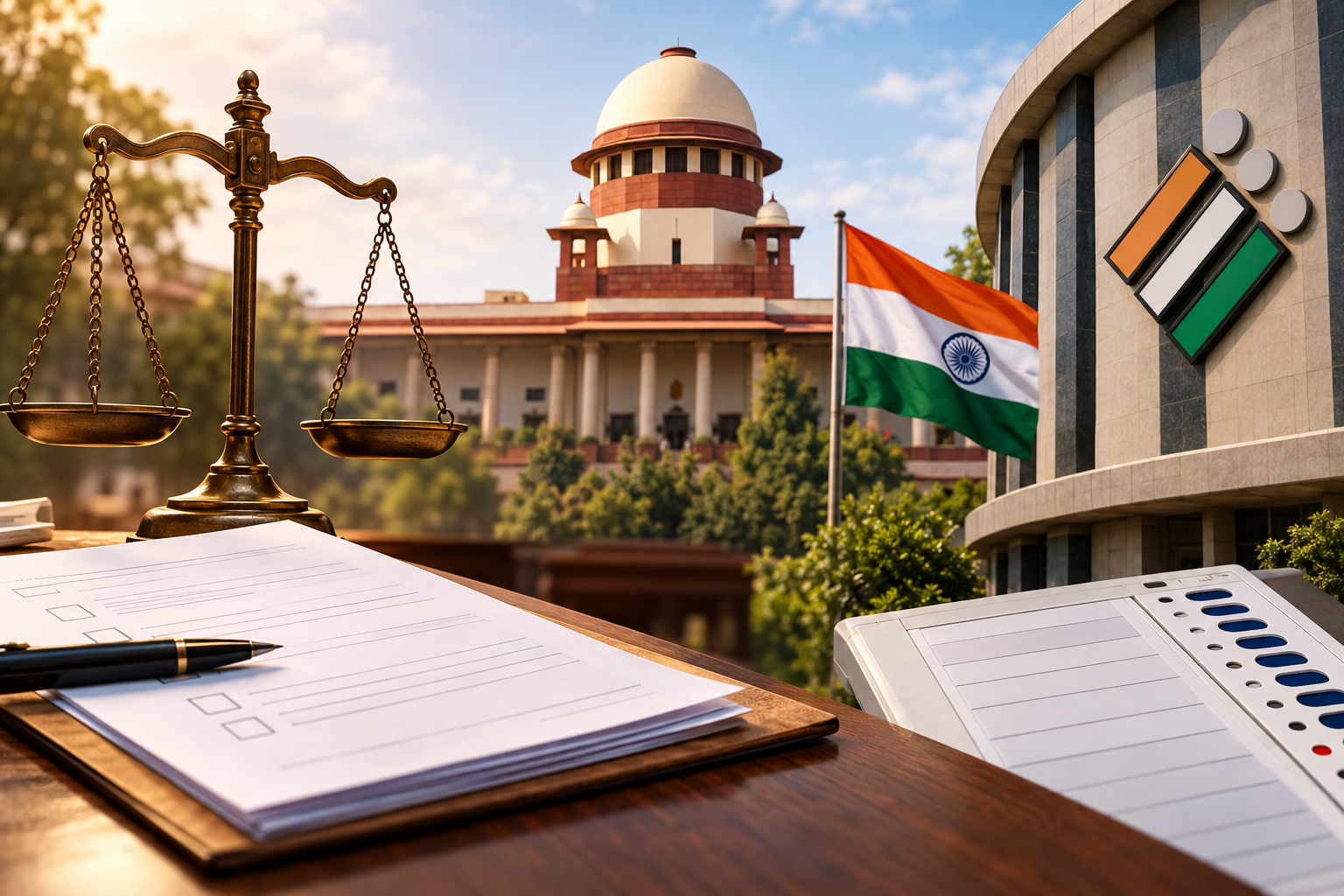
The recent observations of the Hon’ble Supreme Court regarding Form 6 and the additional declaration used during the Special Intensive Revision (SIR) of electoral rolls have unfortunately been seized upon by certain Opposition parties to create an impression that the Election Commission of India (ECI) has acted illegally or unconstitutionally.
That conclusion is neither justified nor supported by the facts presently on record.
The distinction between Form 6 itself and the additional SIR declaration attached to it is extremely important.
The Election Commission has maintained that Form 6, the statutory application for inclusion of a citizen’s name in the electoral roll, was not amended. The additional declaration was introduced as part of the documentation framework specifically for the SIR exercise.
More importantly, the Supreme Court’s judgment of 27 May 2026 on the Bihar SIR recognised that a Special Intensive Revision is different from an ordinary electoral-roll revision and that the Election Commission has administrative discretion to adopt an appropriate documentation framework for such an exercise.
The ECI has therefore not acted in a vacuum. Its SIR framework is based on its constitutional responsibility to ensure that electoral rolls contain the names of eligible citizens and do not contain ineligible entries.
The latest clarification from the Supreme Court must certainly be respected. The Court has said that it did not approve a modified Form 6 and has sought the relevant records to determine what exactly was modified and by whom.
But this clarification cannot reasonably be converted into a declaration that the entire SIR exercise is illegal, or that the Election Commission has no authority to verify the eligibility of voters.
That is where the political narrative being created by sections of the Opposition becomes deeply concerning.
Questioning the Election Commission is legitimate in a democracy. But undermining public confidence in every electoral institution without establishing the facts is a different matter.
Political parties have every right to challenge an action before the courts. They have every right to demand clarification. But repeatedly making sweeping allegations of electoral fraud, criminality or deliberate manipulation before the facts have been judicially established risks damaging public confidence in the very democratic institutions that conduct our elections.
Democracy cannot function on the basis of allegations alone.
If there is a genuine legal violation, let the courts determine it. If there has been an administrative error, let it be corrected. If the Election Commission has acted within its constitutional and statutory powers, that authority must also be respected.
The Election Commission is not above the law. But neither is it below the law merely because a political party disagrees with one of its decisions.
The Opposition has a constitutional role to play. That role includes holding institutions accountable. But accountability should not become a campaign to delegitimise the electoral machinery itself.
Attempts to create fear, confusion and distrust among citizens over the electoral process can have serious consequences. Political disagreement is part of democracy; creating an atmosphere in which citizens lose faith in the electoral system is not a substitute for democratic debate.
DSJP therefore believes that the entire issue must be discussed with constitutional responsibility, legal precision and factual restraint.
The central question should be simple:
How do we protect every genuine citizen’s right to vote while ensuring that electoral rolls remain accurate, transparent and free from ineligible entries?
Both objectives are essential.
The Election Commission must be given the institutional space to perform its constitutional responsibility. At the same time, every action of the Commission must remain open to lawful scrutiny and judicial review.
Let the courts decide questions of law.
Let the Election Commission perform its constitutional duty.
And let political parties debate the issue without creating unnecessary confusion or instability among the people.
India’s democracy is far too important to be reduced to political allegations and counter-allegations.
Facts must prevail over propaganda.
Constitutional institutions must be respected.
And the integrity of every genuine voter’s right must remain paramount.
Harikumar Menon
Vice President
Democratic Social Justice Party (DSJP)
State of Keralam