

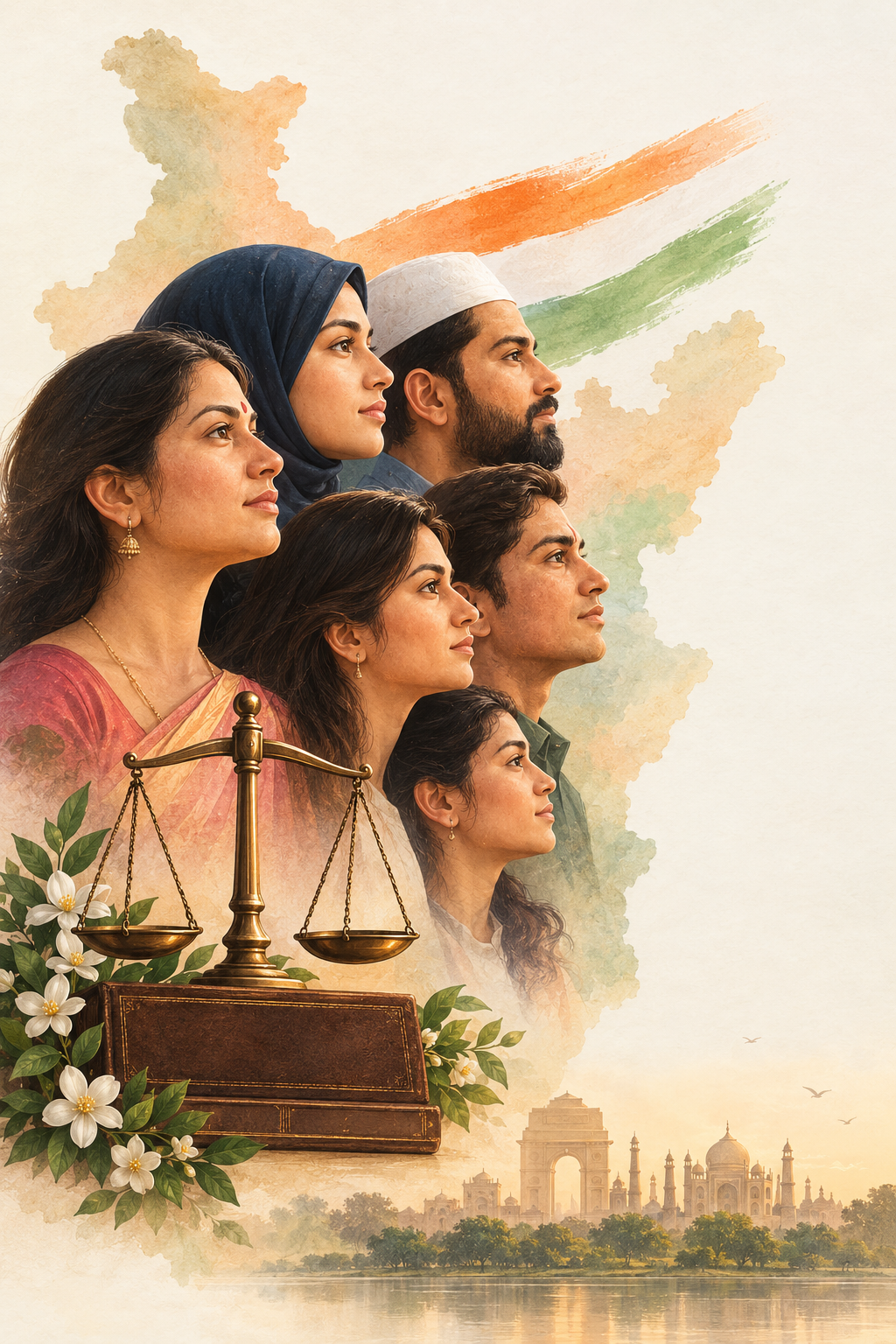
As India approaches 2047, the centenary year of our Independence, our national goal must be to make India one of the most developed, strong and just nations in the world. The vision of “Viksit Bharat @2047” cannot be limited to economic growth alone. Social justice, equality before law, protection of individual rights, gender equality and national unity are equally important components of a developed nation.
It is in this context that we must look at the Uniform Civil Code (UCC).
In India, personal matters such as marriage, divorce, inheritance, adoption and succession are governed by different personal laws applicable to different religious communities. While the traditions and customs of all communities deserve respect, there should be no discrimination among citizens in their legal rights and access to justice.
EQUALITY BEFORE LAW
Equality is one of the fundamental principles of the Indian Constitution. In a modern and progressive society, differences in legal rights relating to personal matters based solely on religion or gender need to be examined in the light of the principle of equality.
The objective of the UCC is not to impose the law of one religion upon another. It’s objective is to establish a common civil legal framework based on equality and justice for all Indian citizens.
PROTECTION OF WOMEN’S RIGHTS
One of the strongest arguments in favour of the Uniform Civil Code is the protection of women’s rights and gender equality.
In matters such as marriage, divorce, property rights, inheritance and adoption, women must have equal legal rights. That is an essential feature of a progressive society.
Irrespective of religion, the rights of women must be equal.
Therefore, the UCC should not be viewed merely as a religious or political issue. It should also be viewed as an important issue of women’s empowerment and social justice.
NATIONAL UNITY AND UCC
The idea of “one nation, one citizenship” should be strengthened by equality before law.
When different personal laws apply to different religious communities, citizens of the same country may be governed by different legal principles in certain personal matters. A well-designed UCC can reduce such differences and strengthen the common identity of Indian citizenship.
The UCC does not mean the abolition of religious freedom. Every citizen has the constitutional right to practise and profess his or her religion. However, there should be a clear distinction between religious practises and civil law governing the rights and obligations of citizens.
VIKSIT BHARAT @2047
If India is to become a developed nation by 2047, economic strength must be accompanied by social and legal modernisation.
As India seeks to compete with the leading nations of the world, our legal and administrative systems must increasingly reflect the principles of equality, simplicity, transparency and justice.
A common civil framework for matters affecting the personal rights of citizens can contribute towards making the legal system more consistent, accessible and equitable.
REFORM THROUGH DIALOGUE
The implementation of the UCC should not ignore the genuine concerns of different sections of society. There should be meaningful consultation with all communities, social organisations, legal experts and people’s representatives.
However, the need for consultation should not become a reason to indefinitely postpone reforms aimed at equality and social justice.
Laws and social institutions must evolve with changing times. That is the hallmark of a vibrant democracy.
DSJP’S STAND
The Democratic Social Justice Party (DSJP) stands for an India founded on social justice, equality and equality before law.
Our objective is to ensure that every Indian citizen enjoys equal rights and equal protection of law, without discrimination based on religion, caste or gender.
Therefore, while protecting the fundamental values of the Constitution and the rights of every individual, and after appropriate consultation with all sections of society, the Uniform Civil Code should be implemented in India as an important step towards a more equal and just society.
UCC is not an initiative against any religion.
It is an initiative for equality.
It is an initiative for women’s rights.
It is an initiative for social justice.
It is an initiative for stronger national unity.
To realise the vision of Viksit Bharat @2047, India needs not only economic growth but also progressive legal and social reforms. The Uniform Civil Code can be an important step towards achieving that vision.
Harikumar Menon
Vice President
Democratic Social Justice Party (DSJP)
State of Keralam
– Harikumar Menon
