

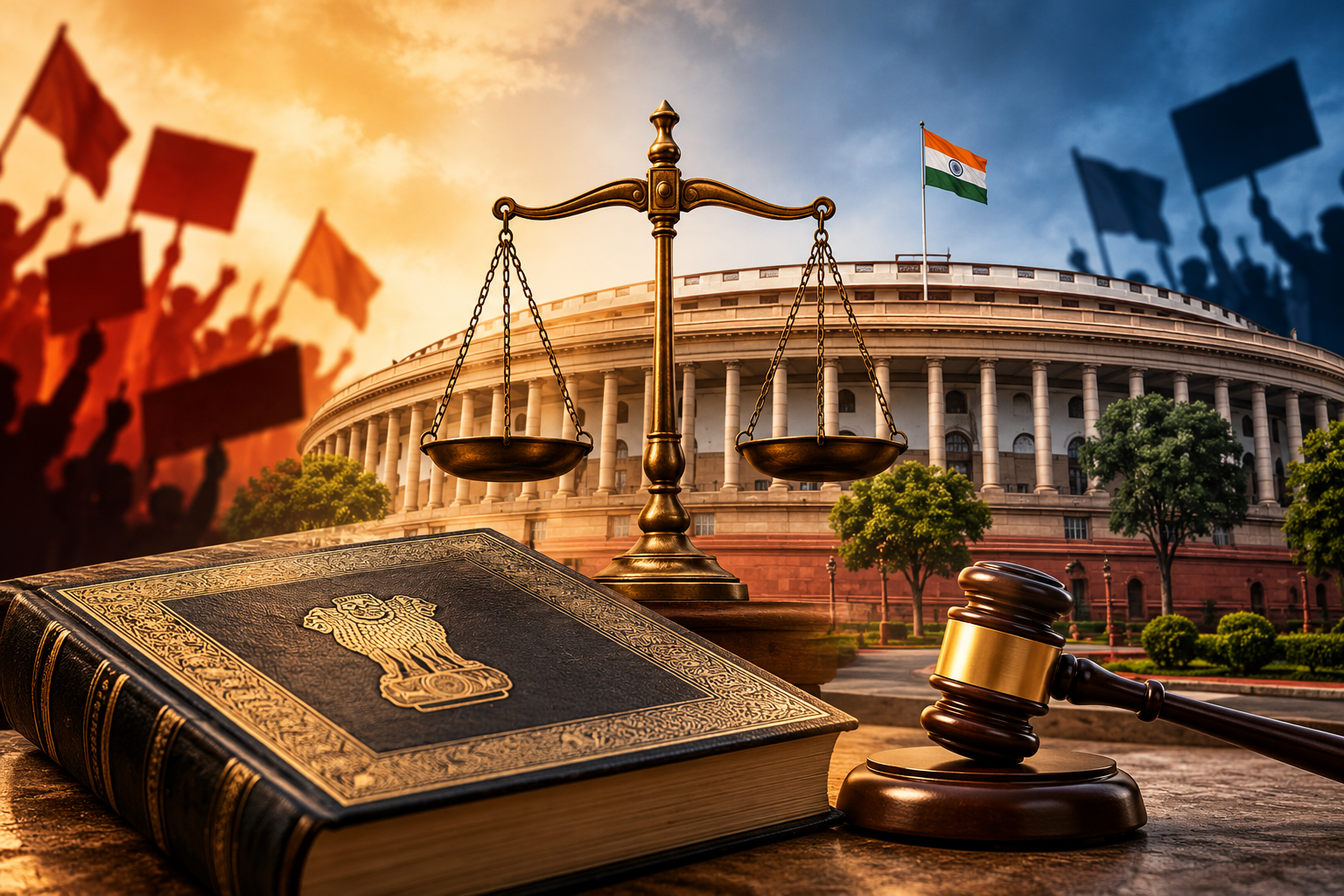
India’s democracy rests not merely on elections and political slogans, but on respect for the Constitution, the rule of law and the independence of constitutional institutions. No political party, however powerful its historical legacy or prominent its leadership, can claim exemption from these fundamental democratic responsibilities.
The agitation led by Rahul Gandhi and the Congress Party against Chief Election Commissioner Shri Gyanesh Kumar raises serious questions about the relationship between political protest, institutional accountability and constitutional propriety.
The Congress Party and other Opposition leaders have levelled serious allegations concerning the Special Intensive Revision (SIR) of electoral rolls and demanded the resignation of the Chief Election Commissioner. Such allegations deserve examination on the basis of evidence. However, allegations must not be confused with established facts, and political mobilisation cannot substitute for due process.
The Election Commission Is Not a Political Adversary
The Election Commission of India is a constitutional institution entrusted with safeguarding the integrity of the electoral process. Its decisions must be open to scrutiny, its procedures must be transparent, and credible allegations of irregularities must be investigated.
However, its authority cannot be treated as illegitimate simply because its decisions are challenged by a political party.
Demanding the resignation of the Chief Election Commissioner while publicly portraying the institution as politically compromised, before the disputed facts have been established, risks undermining public confidence in the electoral process.
If Rahul Gandhi and the Congress Party possess evidence of electoral irregularities, they have every right to present it before the appropriate authorities and courts. But allegations, however forcefully repeated, do not automatically become established facts.
Constitutional accountability requires evidence, due process and reasoned adjudication.
A Direct Question to Rahul Gandhi: Where Is the Evidence?
The meeting between Rahul Gandhi and other INDIA bloc leaders with the President of India, Smt. Droupadi Murmu, raises a fundamental question.
According to public reports, the President asked the Opposition delegation to submit evidence to substantiate its allegations of electoral malpractice. Rahul Gandhi indicated that the Opposition was prepared to provide the evidence it claimed to possess.
As of 28 October 2026, I have not found reliable public confirmation that this promised evidence has been submitted to the President.
This absence of public confirmation does not conclusively establish that no submission has taken place. Nevertheless, it raises a legitimate question: if the Opposition claims to possess compelling evidence of electoral wrongdoing, why has it not publicly demonstrated its case?
Making serious allegations against the Chief Election Commissioner, demanding his resignation and organising political demonstrations are consequential actions. They must be supported by verifiable facts, not merely by repeated assertions or political rhetoric.
The burden of substantiating an allegation rests with the person making it. Rahul Gandhi and the Congress leadership should clarify whether the promised evidence has been submitted and, if so, to whom.
The Supreme Court Must Decide
The Election Commission has submitted a unanimous counter-affidavit in the Supreme Court, presenting its official position on the SIR controversy. The Commission’s submission must be examined alongside the Opposition’s arguments through the judicial process.
The Supreme Court is the final judicial authority on the legal questions before it. Neither Rahul Gandhi nor the Congress Party, nor the Election Commission or the government, can substitute political assertions for judicial adjudication.
If the Opposition believes that the Commission has violated the law, it must substantiate its allegations before the Court. All parties must respect the judicial process and the Court’s eventual decision.
Why, then, should political confrontation take precedence over the constitutional process already available to resolve the dispute?
Democratic Protest Must Be Accompanied by Constitutional Responsibility
India guarantees citizens the right to peaceful assembly and freedom of expression. These rights apply equally to the Opposition, and criticism of public institutions is not inherently undemocratic.
However, democratic freedoms must be exercised with due regard for the law, public order and the proper functioning of constitutional bodies.
No political leader should attempt to substitute street mobilisation for the lawful examination of disputed institutional decisions. The demand for accountability must itself follow constitutional principles.
Opposition Is a Constitutional Responsibility, Not a Licence for Confrontation
A vibrant Opposition is indispensable to Indian democracy. It must question the government, expose wrongdoing, scrutinise electoral procedures and defend the rights of citizens.
However, the Opposition must distinguish between questioning a decision and discrediting an institution before the relevant facts have been examined. Political disagreement should not automatically become a declaration that constitutional authorities are acting in bad faith.
Rahul Gandhi and the Congress Party should ensure that their campaign remains anchored in verifiable evidence, lawful remedies and respect for institutional independence. Where genuine irregularities exist, they must be investigated and remedied. Where allegations remain unsubstantiated, they must not be presented as proven conclusions.
DSJP’s Position:
Constitutional Principles Must Prevail
The Democratic Social Justice Party (DSJP) believes that the strength of Indian democracy lies in the supremacy of the Constitution, equality before the law and the impartial functioning of democratic institutions.
Electoral integrity must be protected through transparent procedures, effective grievance redressal and independent judicial scrutiny wherever necessary. Every eligible citizen must be able to exercise the right to vote, and every credible allegation of wrongful exclusion must receive fair consideration.
At the same time, no political party should presume that street mobilisation alone can establish the guilt of a constitutional officeholder or determine the legitimacy of an institutional decision. Accountability must be secured through evidence and lawful processes.
Rahul Gandhi and the Congress leadership must recognise that the responsibility of a national political party extends beyond mobilising supporters and confronting political opponents. It includes upholding the democratic conventions and constitutional safeguards that protect every Indian citizen, irrespective of political affiliation.
India’s constitutional institutions are larger than any individual leader and more enduring than any political party. Their independence must be protected, their decisions must remain subject to lawful scrutiny, and their authority must neither be immune from accountability nor casually undermined by unproven allegations.
Democracy is strengthened when institutions are questioned through evidence, challenged through law and respected through constitutional conduct. It is weakened when political confrontation threatens to replace these essential principles.
Harikumar Menon
Vice President
Democratic Social Justice Party (DSJP)