

On the Eternal Values of the Ramayana, the Canvas of Art, and the Catharsis of Character
We live in a cultural landscape dominated by noise. Today, if you open a social media feed or look at entertainment headlines, the ancient epic of the Ramayana is frequently dissected through the lens of modern identity politics, academic deconstruction, and media controversies. In an industry where negative publicity is still publicity, the obsession with finding friction, subversion, and controversy can make it feel like the soul of the story is being obscured. But if you strip away the contemporary debates and media maneuvers, the true power of the Ramayana remains entirely untouched. It does not belong to the politics of an era; it belongs to the eternal standard of the Satya Yuga—an age defined by absolute truth, righteousness, and unshakeable cosmic order. When you return to the heart of the epic, it does more than just tell a story. It engulfs the senses, anchoring the human spirit in a profound, moralistic victory of light over darkness.

At the center of this vast narrative stands Shri Rama, designated as Maryada Purushottama—the supreme man who embodies the absolute limit of righteousness. Rama’s life is a masterclass in the values of the Satya Yuga, brought down to earth to serve as a guidepost for humanity. In our world, choices are often dictated by convenience, personal gain, or shifting moral templates. Rama’s choices, however, are dictated solely by Dharma. When he accepts a fourteen-year exile on the eve of his coronation to uphold his father’s word, he demonstrates that a promise is not a transactional agreement; it is a sacred bond. Rama represents the ultimate integration of values: as a son who honors his parents’ word above his own comfort, as a ruler who places the psychological and moral welfare of his citizens above his personal happiness, and as a warrior 1who fights with absolute chivalry, famously telling a weaponless Ravana on the battlefield to go home, rest, and return tomorrow. This isn’t merely historical lore; it is a blueprint for living, reminding us that no matter how chaotic or compromised the external world becomes, the internal compass of truth must remain unyielding.
This unyielding pursuit of truth ripples beautifully across time through an extraordinary spectrum of literary tellings, each reflecting a unique cultural lens while honoring the epic’s core gravity. From the primordial philosophical depths of Vyasa’s reflections to the grand, emotionally charged verses of Kamban’s Tamil masterpiece, and the deeply devotional heights of Tulsidas’s Ramcharitmanas, the narrative shifts its form but never its soul. We see it in the spiritual non-dualism of Ezhuthachan’s Adhyatma Ramayanam in Kerala, which transforms the epic into an internal journey of liberation. It expands beyond geographical borders into Thailand’s national epic, the Ramakien, where the narrative integrates into the cultural fabric of Southeast Asia with vibrant dramatic flair, and it breathes through the compassionate moral frameworks of the Buddhist Jataka tales. Rather than diluting the text, these rich variations prove that the Ramayana is an eternal canvas—capable of being re-sung in a hundred tongues while its core moral baseline remains completely absolute.
One of the most beautiful literary and spiritual dimensions of this epic canvas is how it utilizes its negative characters. They are not merely villains designed to be hated; they are precisely calibrated counterweights. Every shade of darkness in the epic exists to make the light shine brighter, proving that good is not just a passive trait, but a triumphant force. Ravana is not an ignorant man; he is a master of the Vedas, a profound scholar, and a king of unmatched wealth and power. Yet, his immense knowledge is completely consumed by his ego. By placing Ravana’s colossal arrogance next to Rama’s quiet, unassuming humility, the epic teaches us that brilliance without character is a hollow shell. Similarly, driven by toxic whispers, 2Kaikeyi succumbs to fear and greed, setting a stark contrast to Sita’s magnificent fortitude as she willingly walks into the rugged wilderness out of sheer devotion. Even within Lanka, Vibhishana’s choice to abandon his own bloodline for universal truth highlights that true loyalty belongs to righteousness alone. Without the depth of the shadows cast by Lanka, the blinding brilliance of Ayodhya’s virtues would not be as vivid.
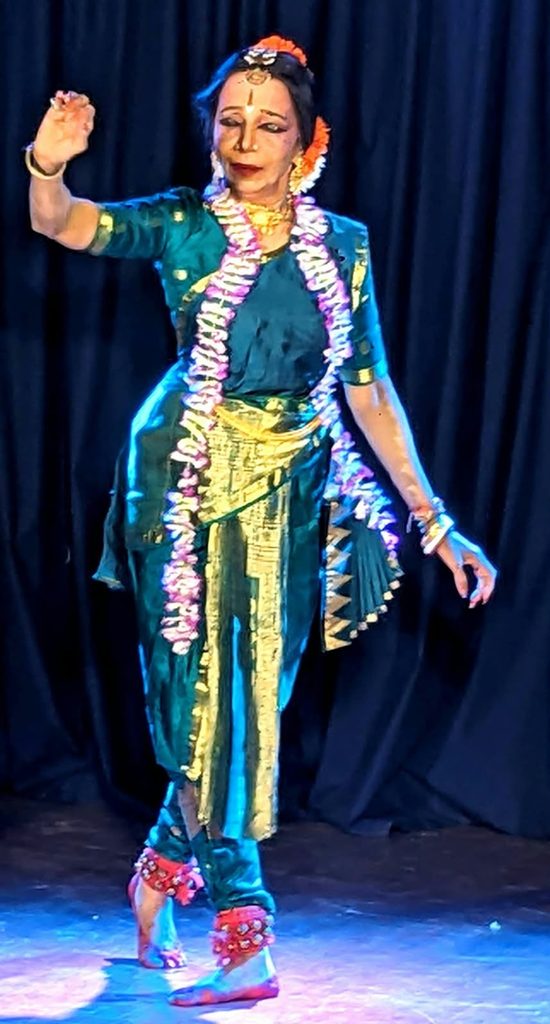
For an artist, this magnificent interplay of light and shadow becomes something deeply personal, transcending the boundaries of reading or viewing. As a dancer stepping onto the sacred stage, the characters of the Ramayana are danced completely beyond the rigid folds of gender, time, or physical identity. Within the duration of a single performance, the dancer’s body becomes a vessel for both the unbending dignity of Rama and the profound, resilient grace of Sita; it channels both the tragic arrogance of Ravana and the serene devotion of Hanuman. In this sacred space, the binary divisions of the mundane world dissolve entirely. To embody these cosmic archetypes is to experience a deep emotional cleansing—a true catharsis that washes away the trivial anxieties of daily life. The physical movement, the emotive abhinaya, and the rhythmic footwork merge into a form of regenerative therapy, providing a profound sanctuary where the spirit is realigned with ancient, universal truths. This is the timeless alchemy shared by all classical art forms, whether it be theatre, music, or dance: they distill the external noise, controversies, and media-driven negativity into pure, therapeutic alignment, returning the human consciousness to its pristine source.
It is easy to get caught up in the modern media cycle, where ancient texts are treated as battlegrounds for contemporary headlines. But the Ramayana has survived millennia precisely because it is an anchor, not a sail. It does not shift with the winds of current trends. When we breathe in the essence of this epic and live it through the lens of art, we are reminded that the victory of good over evil is a cosmic inevitability. The Ramayana asks us to look past the superficial 3controversies and focus on the timeless thread of values running through it. In a world obsessed with publicity, fame, and noise, let us choose to be anchored in the quiet, triumphant dignity of Rama. Let us remember that truth does not need to shout to survive; it simply needs to be lived.
“The epic does not merely record a battle fought across ancient bridges and stone ramparts, it mirrors the quiet, eternal struggle within the human heart—proving that while darkness may build grand castles of illusion, it is the simple, unyielding light of character that ultimately endures !” The eternal promise of a great Sage: यावत् स्थास्यत गिरयः सरतश्च महीतले । तावद् रामायणकथा लोकेषु प्रचरष्यत ॥ Yāvat sthāsyanti girayaḥ saritaś ca mahītale | Tāvad rāmāyaṇakathā lokeṣu pracariṣyati || “As long as the majestic mountains stand and the sacred rivers flow upon the surface of the earth, so long shall the glorious story of the Ramayana flourish and be told among humanity.” — Valmiki Ramayana, Bala Kanda (Book 1), Chapter 2, Verse 36
By Kalashri Dr Lata Surendra (A dual State Awardee, Bharatanatyam Exponent, Teacher, Choreographer, Writer, Curator, Independent Researcher, Dance Journalist and poet in the field of Dance for over Six and half decades) 4