

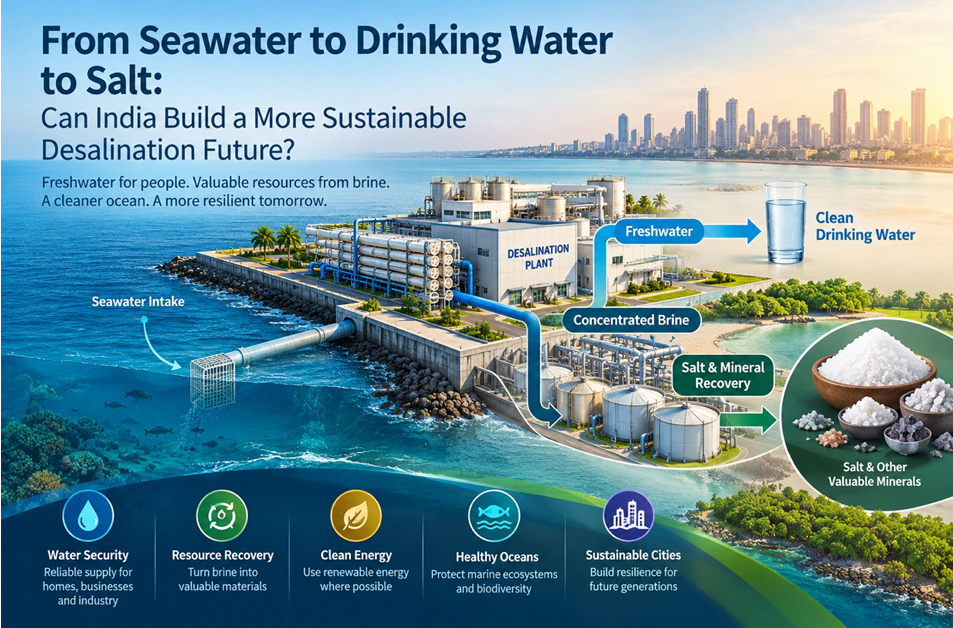
Why Mumbai’s water security may depend not just on desalination, but on recovering value from everything the process produces.
Mumbai is surrounded by the Arabian Sea, yet every summer, the city finds itself looking to the skies for water. Should a city with such an extensive coastline still be so dependent on the monsoon for its water security?
As reservoir levels fall and the prospect of water cuts returns, we need to ask whether Mumbai is making full use of the resources available to it. With a growing population, expanding industries and increasing pressure on existing freshwater supplies, relying predominantly on rainfall-fed reservoirs may not be enough to secure the city’s long-term needs.
Could seawater desalination become another pillar of Mumbai’s water strategy? And could we go a step further by recovering salt and other valuable minerals from the concentrated brine left behind, turning a potential waste stream into a useful resource?
Having grown up in the Kingdom of Bahrain, I witnessed how desalination became an essential part of everyday life in a country with extremely limited natural freshwater resources. That experience shaped my perspective on how strategic investment in technology and infrastructure can help address water scarcity.
Advances in reverse osmosis (RO), membrane technology, energy recovery, automation and process engineering have made seawater desalination increasingly practical in many parts of the world. For Mumbai, the opportunity is to explore how these technologies could strengthen water security while protecting marine ecosystems and recovering additional value from the resources we use.
Perhaps it is time Mumbai stopped looking at the sea merely as its boundary and started considering it as part of the solution to its water future.
What if the future of desalination were not simply about extracting freshwater from seawater, but also about recovering salt and other useful minerals from what remains?
Could we build systems that produce drinking water, recover commercially valuable materials and minimise waste, while protecting the marine environment? It is an idea worth exploring seriously.
1. The untapped potential of the sea
Reverse osmosis works by pushing seawater through specialised membranes under pressure. The membranes allow water to pass through while retaining most of the dissolved salts and other constituents.
The process produces two principal streams: freshwater, which requires appropriate post-treatment before distribution, and a concentrated saline stream known as brine. Desalination plants commonly manage this brine through carefully designed discharge systems. However, its elevated salinity, residual treatment chemicals and other characteristics can pose environmental risks if not properly managed.
This concentrated stream also contains dissolved substances that may have commercial value. Instead of considering brine exclusively as a waste product, we could investigate whether a portion of its contents can be recovered economically and responsibly. This brings us to an important concept: resource recovery from desalination brine.
2. Can we extract pure salt from desalination brine?
Yes, in principle. Salt recovery is technically possible, although producing a commercially viable, high-purity product requires additional processing. Several technologies can contribute to the process.
- Evaporation and crystallisation: Further concentrating the brine allows dissolved salts to form crystals, which can then be separated and processed.
- Membrane-based concentration: Additional membrane processes can remove more water from the brine before crystallisation, potentially reducing the energy required by subsequent stages.
- Thermal concentration: Technologies such as membrane distillation and mechanical vapour compression can help concentrate saline streams under suitable operating conditions.
- Selective mineral recovery: Depending on the chemistry of the brine, additional processes may recover magnesium and calcium compounds, potassium-containing products or other useful constituents.
These technologies are not interchangeable, and not every recovery process is economically viable at every location. The choice depends on the brine composition, energy costs, plant size, equipment requirements and the market for the recovered materials.
There is also a critical distinction between recovering salt and producing pure sodium chloride. Seawater contains several dissolved salts and minerals. The crystals obtained from brine may therefore require further separation, purification and testing. Industrial-grade salt may be suitable for certain applications, but edible salt must meet the relevant food-safety and purity standards. The opportunity is real, but it needs to be evaluated through sound engineering rather than assumptions.
3. The advantages: Turning a by-product into a resource
A. Creating value from concentrated brine
Salt is an essential raw material for numerous industrial processes. If recovered material meets the required specifications, it could potentially be used in selected industrial applications. In suitable circumstances, recovering salt could generate additional revenue or offset some of the costs associated with brine management. However, profitability would depend on the quality and quantity of the recovered product, the cost of processing it and the availability of reliable buyers. The objective should be to establish a commercially sound recovery process, not simply to produce salt without a practical market.
B. Reducing the volume of liquid waste
Further concentration and recovery processes can reduce the amount of liquid requiring disposal. This is particularly relevant to Minimal Liquid Discharge (MLD) and Zero Liquid Discharge (ZLD) approaches. These aim to reduce or eliminate routine liquid discharge from a process by recovering additional water and managing the remaining concentrated material.
Salt extraction alone does not guarantee ZLD. The complete process must account for residual liquids, treatment chemicals, contaminants and the final destination of solid waste. Nevertheless, resource recovery could form an important part of a more comprehensive brine-management strategy.
C. Recovering other useful minerals
Salt is only one potential product. Depending on the composition of the brine and the technologies employed, other dissolved substances may be recoverable. These could have applications in chemical manufacturing, industrial processing and other sectors. However, extracting each additional substance requires suitable separation methods, investment and energy. Some recovery opportunities may prove commercially attractive, while others may not. A detailed chemical analysis of the brine should therefore precede any investment decision.
D. Supporting a circular economy
A circular economy aims to make better use of resources and reduce unnecessary waste. An integrated desalination facility could potentially recover freshwater, extract selected materials and minimise the residual waste stream. This would represent a shift from viewing desalination as a single-purpose water-production process towards treating it as part of a wider resource-management system.
The guiding principle is straightforward: recover what is useful, minimise what is wasted and manage what remains responsibly.
4. The disadvantages: Why salt recovery is not a simple solution
The potential benefits must be weighed against significant technical, financial and environmental challenges.
A. Additional energy consumption
Recovering salt requires more than the energy already used to produce freshwater. Further concentration, evaporation, crystallisation and purification can consume substantial amounts of energy, depending on the process. If this energy is expensive or carbon-intensive, the environmental and economic benefits may be reduced.
Renewable electricity, waste-heat integration and efficient process design could improve the overall balance, but the energy requirement must be measured for each proposed facility.
B. High investment and operating costs
An RO plant already requires substantial capital expenditure for seawater intake, pretreatment, membranes, high-pressure pumps, post-treatment and water distribution. Adding salt recovery introduces further equipment, maintenance, chemicals, energy consumption and operational complexity.
The additional revenue from salt and minerals may not cover these costs. A feasibility study must therefore assess the entire lifecycle cost of the facility, including capital investment, operating expenses, product purification, transportation and waste management.
C. Product quality and market demand
Recovering a material does not automatically make it commercially useful. The salt must meet the specifications required by its intended market. Contaminants and other dissolved minerals may complicate purification, while the available market may not be large enough to absorb the quantity produced.
Food-grade applications demand particular care and compliance with applicable safety standards. Before a plant is designed around salt recovery, prospective customers, product specifications and realistic selling prices should be established.
D. The risk of creating another waste stream
If the recovered salt contains unwanted contaminants or cannot be sold economically, it may accumulate as waste. Likewise, separating one mineral can leave behind another concentrated stream that still requires management.
Resource recovery should therefore be judged by the overall environmental and economic outcome—not merely by the quantity of salt extracted.
5. Does desalination harm the ocean?
This is one of the most important questions in any discussion of large-scale desalination, particularly for a coastal city such as Mumbai. Desalination is not inherently harmless. Its environmental impacts depend on how the plant is designed, where it is located, how it operates and how its residual streams are managed. There are three principal concerns.
a. Seawater intake: Poorly designed intake systems can trap or draw in fish, larvae, plankton and other marine organisms. Appropriate intake design, screening and careful site selection can reduce these impacts.
b. Concentrated brine discharge: Brine is generally saltier than the surrounding seawater. If discharged without adequate consideration of local currents, water depth, mixing and marine ecology, it can create localised conditions that stress sensitive organisms.
c. Treatment chemicals and residual waste: Chemicals used in pretreatment, membrane cleaning and other operations must be managed responsibly to prevent unacceptable environmental contamination.
Salt recovery may reduce the volume of brine requiring discharge, but it does not automatically eliminate these risks. A complete environmental assessment must consider the intake, the entire treatment process, the final discharge and any solid waste produced.
Responsible desalination must include marine monitoring, suitable discharge design, transparent environmental assessments and continuing oversight.
6. Mumbai must protect its natural coastal defences
There is another concern that deserves equal attention: the loss of mangroves, marshlands and other coastal ecosystems through encroachment and poorly planned development. These ecosystems support biodiversity, help buffer coastal areas against flooding and storms, and contribute to the health of the wider marine environment.
Desalination must never become an excuse for further destruction of these natural systems. A water-security strategy that damages the ecosystems on which coastal resilience depends would be fundamentally counterproductive.
The objective should be to strengthen Mumbai’s water infrastructure while preserving its natural coastal defences. Plant location, seawater intake, discharge routes and associated infrastructure must all be assessed with these priorities in mind. Engineering should work with environmental science, not against it.
7. Could Mumbai pioneer integrated desalination and resource recovery?
Mumbai has several advantages worth considering: access to the Arabian Sea, a substantial industrial and commercial economy, engineering expertise, research institutions and growing opportunities to integrate renewable energy.
However, a large desalination facility would need to be evaluated against its full costs and benefits, including the cost of producing and distributing freshwater, energy requirements, environmental impacts and the economics of salt recovery.
A sensible starting point would be a detailed feasibility study followed by a pilot project, where justified. An integrated facility could investigate:
- Reverse osmosis for freshwater production.
- Further concentration of brine to recover additional water.
- Salt crystallisation and purification for suitable industrial markets.
- Selective recovery of other minerals where technically and commercially justified.
- Renewable energy and waste-heat integration where feasible.
- Safe management of residual liquids, treatment chemicals and solid waste.
- Continuous monitoring of marine ecosystems and discharge quality.
The objective would not be to achieve every possible form of recovery at any cost. It would be to determine which combinations deliver genuine economic and environmental benefits under Indian conditions.
The same approach could be evaluated for other coastal cities, including Chennai, Visakhapatnam and Mangaluru, with each project designed around its own geography, industrial demand, energy availability and environmental constraints.
8. Desalination should be one pillar of water security
Even the most advanced desalination facility cannot replace the need for responsible water management. Rainwater harvesting, wastewater recycling, leakage reduction, watershed protection and the conservation of existing reservoirs remain essential. Desalination should diversify the water supply rather than simply create another source to be used without restraint.
If a city can meet part of its demand through desalinated seawater, it may gain greater flexibility in managing its reservoirs during periods of drought. But the actual benefits would depend on the scale of production, affordability, distribution infrastructure and how the water system is operated.
The long-term objective should be a resilient and diversified water network that can withstand increasingly unpredictable weather, population growth and changing industrial demand.
9. The question we should be asking
Growing up in Bahrain taught me that water security is not determined solely by the amount of freshwater a country naturally possesses. It also depends on planning, infrastructure, engineering and the willingness to invest before a crisis arrives.
India’s coastal cities have an opportunity to examine how desalination can contribute to that future. But perhaps we should look beyond the conventional model of taking freshwater from the sea and returning concentrated brine to it.
- Could we recover additional water?
- Could we extract salt and selected minerals where it makes economic sense?
- Could we use renewable energy more effectively?
- Could we reduce waste while ensuring that marine ecosystems remain protected?
These questions deserve serious research, transparent economic evaluation and collaboration between engineers, environmental scientists, industry and policymakers. The answer will not be the same for every city or every desalination plant. Some recovery technologies will be practical; others may consume too much energy or cost too much to justify their use. The challenge is to identify the right solutions for the right locations.
The future of desalination should not be measured only by how much freshwater we produce, but also by how efficiently we use resources, how responsibly we manage waste and how carefully we protect the environment.
For Mumbai, the Arabian Sea is more than a geographical boundary. It could become an important component of a diversified water-security strategy—provided we approach it with scientific rigour, environmental responsibility and a long-term vision.
What do you think?
Should India invest in pilot projects that combine large-scale reverse osmosis desalination with salt and mineral recovery? Could the potential benefits justify the additional energy and processing costs, and what safeguards should be mandatory to protect marine ecosystems?
I’d welcome perspectives from water-treatment engineers, marine scientists, industrial salt producers, energy specialists and policymakers.
#WaterSecurity #Desalination #ReverseOsmosis #SaltRecovery #BrineManagement #CircularEconomy #MarineConservation #WaterTechnology #Sustainability #ClimateResilience #Engineering #Mumbai #India #RenewableEnergy #Infrastructure

VIJAY THOMAS KURIEN