

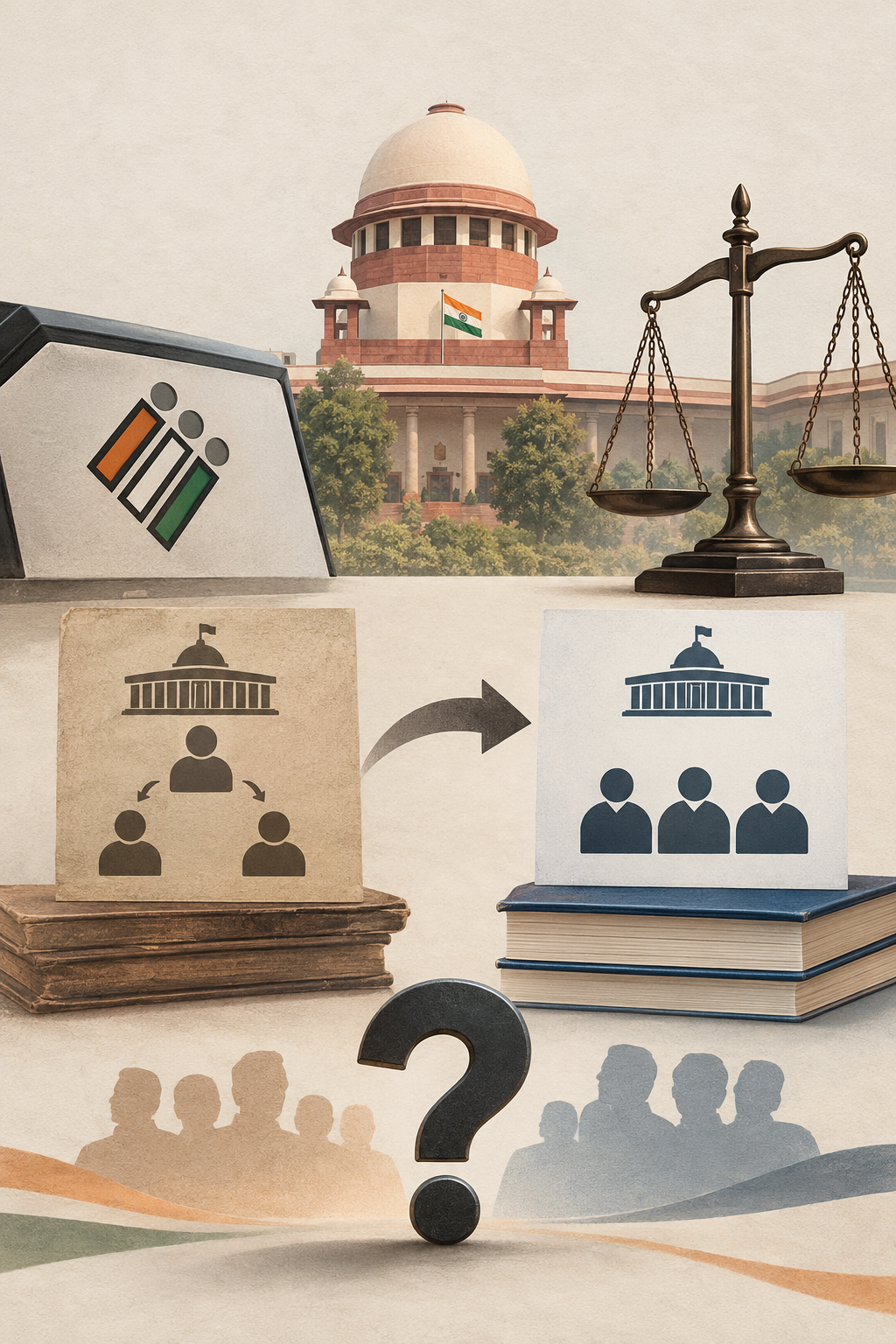
The Opposition repeatedly objects to the present system because the Chief Justice of India is not a member of the Selection Committee for the Chief Election Commissioner and Election Commissioners.
But let us look at the history before making such an allegation.
For more than seven decades, including throughout the long period when the Congress was in power, the appointment of the Chief Election Commissioner and Election Commissioners was made by the President on the advice of the Prime Minister. The Supreme Court itself has recorded that, under the system then prevailing, the Prime Minister was empowered to decide the persons to be appointed.
There was no statutory selection committee comprising the Prime Minister, the Leader of Opposition and the Chief Justice of India.
The present government changed the system through legislation. Under the 2023 Act, the Selection Committee consists of the Prime Minister, the Leader of Opposition in the Lok Sabha and a Union Cabinet Minister nominated by the Prime Minister. Thus, the Leader of Opposition has a statutory place in the selection process today.
Yet the same Opposition that functioned for decades under a system in which the Prime Minister effectively decided the appointments now raises the loudest objections when the present government introduces a statutory selection mechanism that includes the Leader of Opposition.
Isn’t there an element of political inconsistency in this criticism?
If participation of the Opposition is considered important for ensuring transparency and wider consultation today, why was such a mechanism not established during the many years when the Congress was in power?
And there is another legitimate institutional question: if the CJI participates in selecting an Election Commissioner and a dispute concerning that appointment or the Commissioner’s actions later reaches the Supreme Court, a potential conflict—or at least a perception of conflict—can arise. That does not automatically disqualify the CJI, but it is a consideration that cannot simply be dismissed.
The Election Commission must undoubtedly remain independent. But independence should be protected through sound constitutional and institutional arrangements, not through selective political arguments based on who is in power.
The Opposition has every right to question the present law. But it should also answer a simple question:
Why was the demand for a broader statutory selection mechanism not implemented when the Congress was in power for so many decades?
Harikumar Menon
Vice President
Democratic Social Justice Party (DSJP),
State of Keralam