

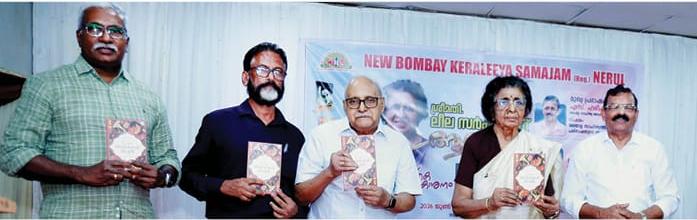
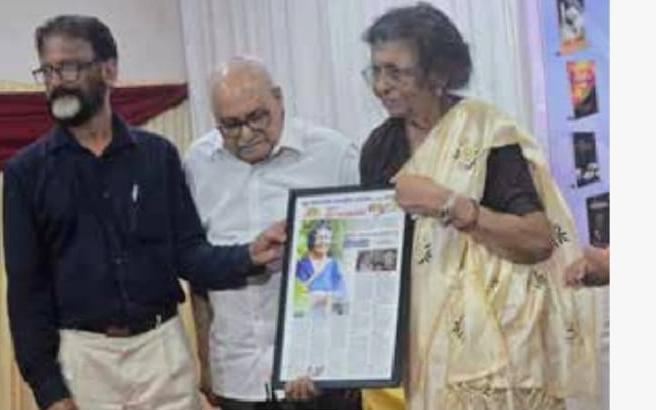
Mumbai: Celebrated translator and Sahitya Akademi awardee Leela Sarkar was felicitated by the New Bombay Keraleeya Samajam at a function held at the Samajam Hall in Nerul on 14th of June , recognizing her outstanding contribution to introducing Bengali literary classics to Malayalam readers and promoting literary exchange between Malayalam and Bengali.
A recipient of both the Sahitya Akademi Award and the Kerala Sahitya Akademi Award, Leela Sarkar has translated more than a hundred Bengali works into Malayalam, including the widely acclaimed Byomkesh Bakshi detective series. She has also translated several important Malayalam literary works into Bengali, making a significant contribution to strengthening ties between the two literary traditions.
The programme was inaugurated by noted novelist Balakrishnan, who described it as a privilege to participate in the felicitation of a person whom he considers a member of his own extended family.
Delivering the keynote address on “The Contribution of Translation to Malayalam Literature,” acclaimed writer S. Hareesh highlighted the vital role translation has played in shaping cultures and civilizations. He remarked that many of Kerala’s most vibrant cultural activities continue to flourish outside the state and emphasized that translation has historically served as a bridge between languages, societies, and knowledge systems.
Drawing references from world history, Hareesh pointed to the multilingual inscription carved in Egypt in 196 BC and noted that the development of major world languages, the European Renaissance, and scientific progress were greatly influenced by the translation of religious and scholarly texts across cultures. He observed that Malayalam possesses one of the richest translation traditions among Indian languages due to its openness to external influences.
Hareesh also paid tribute to Benjamin Bailey, describing him as one of the architects of modern Malayalam prose. At a time when Malayalam lacked a developed prose tradition, Bailey transformed the language from a largely poetic medium into one capable of sustaining modern prose writing, he said, adding that his contribution deserves recognition alongside that of Thunchaththu Ezhuthachan.
Speaking about landmark translations in Malayalam, Hareesh cited Nalappat Narayana Menon’s translation of Victor Hugo’s Les Misérables as a turning point in the language’s literary history. He recalled that Vallathol Narayana Menon had reportedly pledged his own poetry collections to support the publication of the work. The translation, he said, not only brought world literature closer to Malayalam readers but also enriched the language itself, introducing expressions such as “red tape” and “born with a silver spoon in one’s mouth” into common usage.
The noted writer further observed that the works of Leo Tolstoy, Fyodor Dostoevsky, Maxim Gorky, and One Hundred Years of Solitude had left a deep imprint on Malayalam literature. He credited translators such as K. Ravivarma, Sathyarthi, and Leela Sarkar for introducing generations of readers and writers to these literary traditions. According to him, the translations produced by these scholars helped shape the imagination of a new generation of Malayalam writers, including himself. Hareesh acknowledged that his own novel Pattunoolpuzhu bears traces of this literary influence.
He added that honouring figures like Leela Sarkar, whose work has become part of Malayalam literary history, contributes significantly to the strengthening of cultural life.
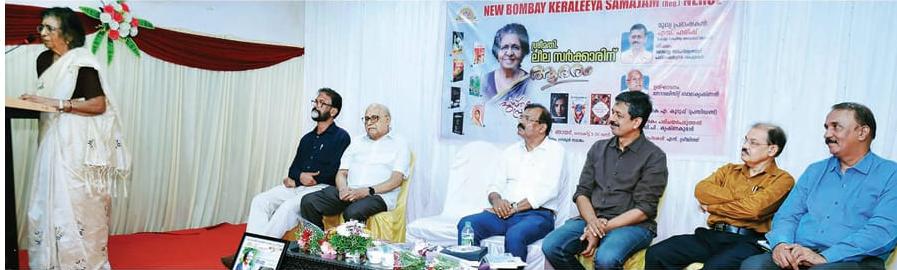
In her response, the nonagenarian translator expressed gratitude for the recognition and said that despite receiving numerous awards throughout her career, this was the first time a Malayalam cultural organization in the region where she resides had honoured her.
C. P. Krishnakumar introduced the audience to Leela Sarkar’s literary journey and her extensive contribution to translation. The event also featured the release of three books translated by Leela Sarkar. Among them was the Malayalam translation of renowned Bengali writer Buddhadeb Guha’s celebrated work The Story of a Hunter, published as Oru Naayattukaarante Kadha. The first copy was presented by C. P. Krishnakumar to M.P.R. Panicker, Convenor of Aksharasandhya.
Veteran journalist N. Sreejith conveyed his greetings at the function. Welcoming the gathering, Samajam General Secretary Prakash Kattakkada announced that a dedicated section featuring Leela Sarkar’s works would be established in the Samajam library.
The function was presided over by Samajam President K. A. Kurup, while T. Mohanasundaran delivered the vote of thanks.