

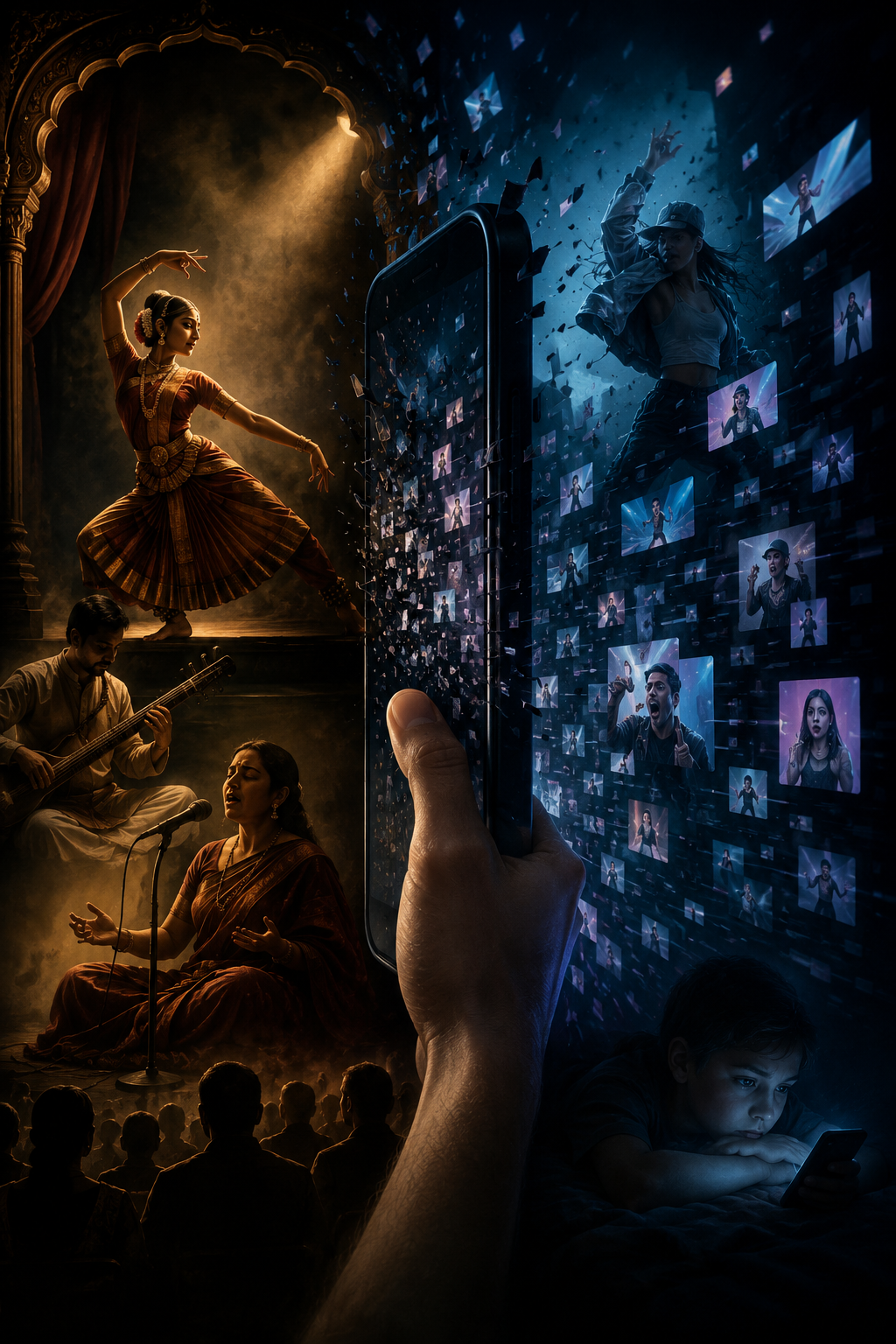
We have reduced the vastness of human expression, the agonizing architecture of art and the very rhythm of life to a fleeting thirty-second glance. In the modern cultural landscape, thirty seconds is no longer a mere unit of time, it is a violent trial. It is the maximum boundary of human attention before the thumb twitches, the screen changes,and the psyche shifts. Yet we
wonder why a relentless, automated loop of these same thirty seconds leaves us completely reeled. We are caught in a hypnotic vertigo, spun around by a carousel of fragments that mimic depth but offer only a momentary spark. Time it was, when surrender to the aesthetics cradling art was ever so vital. To watch a classical dancer trace the geometry of grief across a stage ; to hear a vocalist hold a single, trembling note until it fractured the silence, or to witness a theatrical monologue build its emotional scaffolding over the course of hours—these required a shared covenant of time. It was absolutely ‘a transaction of presence. Today, that covenant is broken. The performing arts, which inherently require duration, space and a gradual unfolding of the human spirit, are being suffocated by the tyranny of the immediate. We do not look at art anymore; we glance at it. We do not listen to life; we sample it. In this rapid-fire truncation of reality, the soul of performance is being systematically erased. In this accelerated wasteland, a brutal modern truth has emerged: today’s algorithms don’t bow to genius; they bow to gravity. They reward the relentless over the refined. The recommendation engines that dictate global culture do not possess an aesthetic conscience; they are mathematical structures designed to measure friction, velocity, and retention. They do not care if a piece of music took ten years of monastic training to perfect or if a choreography carries the sacred weight of a lineage.The algorithm recognizes only the signal of volume. Consequently, the digital arena now belongs to a new breed of creator: the shamelessly consistent. While quiet brilliance sits in the shadows, paralyzed by self-doubt and waiting foolishly for a discovery that may never come, mediocrity commands the global spotlight through the sheer force of a thick skin and a daily post. This regularity has transformed from a marketing tactic into a supreme systemic advantage.
The internet does not crown the most gifted; it crowns the most visible. To survive in this space, the modern creator must possess an emotional callousness that is fundamentally at odds with the sensitivity required to make great art. The true artist is thin-skinned; they bleed through their work, opening themselves up to the world to capture raw truth. But the algorithm demands a machine-like output. It requires individuals who can absorb the void of internet indifference,
ignore the internal voice of quality control and upload their existence every single day without blinking. The mediocre do not win because their work is transcendent; they win because they out-last,out-post,and scream over the digital noise until the system has no choice but to turn their repetition into a wave.
The tragedy would be contained if it remained confined to the chaotic wild-west of social media platforms. But the rot has spread inward, compromising the very foundations of cultural stewardship. Organizers, festival directors, and cultural entrepreneurs now foolishly look into these fleeting digital loops to accord opportunities, book talent, and measure relevance. When casting a play, booking a concert, or curating a festival, the contemporary gatekeeper no longer asks to see the artist’s credentials, their training, or the depth of their repertoire. Instead,they ask for their metrics. They look at the follower count, the engagement rate, and the virality of their latest thirty-second reel. In doing so, these organizers have abdicated their responsibility as tastemakers. They have outsourced their judgment to a soulless code, mistaking digital visibility for artistic viability. This capitulation has sent our once-sacred standard of credibility entirely into the twilight zone. An artist who has spent decades refining their craft in obscurity is bypassed for a viral sensation whose talent begins and ends within the borders of a phone screen. The stage, once a temple of rigorous mastery, is being populated by influencers who can
command an audience’s attention for half a minute but crumble when asked to sustain a performance for an hour. The criteria for authority have been completely inverted. Excellence is no longer self-evident; it is secondary to the spectacle of self-nomination. Beneath this obsession with visibility lies a psychological affliction that now rules the creative process: completion
sickness. In the modern paradigm, the ultimate objective of a performance is no longer evolution, but finality.
Artists have become obsessed with the sheer act of finishing a project, checking off an event, and immediately uploading the “completed” asset to the digital void. The goal is simply to have done it, to cross the finish line, to harvest the immediate digital validation, and to rush onto the next cycle of production. This sickness has entirely destroyed the sacred interior space where an artist must improve upon themselves, performance after performance. Historically, the stage was a laboratory of iterative growth. A dancer or musician did not perform to finish a piece; they perform to inhabit it. Each live showcase was an opportunity to dissect their own execution, to find nuance in a mistake, and to return to the studio the next morning with an insatiable hunger to refine their posture, their breath, and their depth. True artistry lives in this infinite feedback loop of self-correction. Today, completion sickness cuts this loop short. When a performance is viewed merely as a milestone to be archived online, the drive for introspective polish dies. The performance does not deepen; it merely repeats, freezing the artist in a state of permanent, celebrated stagnation. To mask this lack of internal growth, the modern stage has turned to sensory inflation. Youngsters, stripped of the patience required to master foundational technique, increasingly compromise with the very grammar of their art forms. They lack the core vocabulary—the flawless pitch, the precise posture, the deliberate silence—and instead substitute substance with a hollow, macro-level spectacle. This compromise is weaponized through coordinated costuming of pure quantity and a reliance on elaborate, distracting props.
The stage is no longer a canvas for individual brilliance; it is an over-crowded canvas of synchronized visual noise. If twenty performers are dressed in identical, blindingly brilliant costumes moving in a single, geometric mass, the individual viewer’ s eye is dazzled. If the stage is cluttered with smoke machines, LED screens and heavy props that constantly divert attention, the audience forgets to look at the actual technique. This is a deliberate illusion because the grandeur of the ensemble hides the frailty of the individual. Grand costuming and overwhelming props act as a cosmetic shield, allowing young performers to bypass the grueling, repetitive years of basic training. They are taught to execute a spectacle rather than to embody a craft. The audience leaves entertained by the geometry of the mass, completely unaware that the foundational grammar of the art form has been quietly mutilated right in front of them.
The final, most devastating blow to the performing arts is occurring at the highest institutional levels. Historically,when the marketplace fell prey to cheap commercialism, a country’s authentic national academies, state-sponsored councils, and elite cultural institutions stood as the ultimate bulwarks of quality. They were the custodians of heritage, tasked with protecting classical traditions, avant-garde experimentation and non-commercial art forms from the whims of popular fad. They were meant to accord merit based on historical depth, technical mastery and artistic integrity. Today, even these venerable bastions are surrendering to the tide. In an anxious bid to prove their own “relevance” to a younger demographic and justify their state funding, national academies are increasingly aligning their criteria with the values of the digital marketplace. When awarding national fellowships, grants and prestigious cultural titles, committees are quietly scanning the digital footprint of the nominees. They are looking for the obvious “I know connections” links—the incestuous networks of online mutual promotion where popularity is traded like currency. This systemic bias dilutes merit at its very source. When a country’s highest cultural bodies begin to validate the superficial over the substantive, the incentive to pursue artistic mastery dies. Young performers realize that years of grueling practice under a master will yield fewer rewards than a well-timed, algorithmic trend. The authentic academies, by rewarding those who have successfully commercialized their identities rather than those who have deepened their art are actively participating in the execution of their nation ‘s cultural heritage. They are replacing the timeless ledger of merit with the transient scoreboard of the feed. The direct consequence of this shift is a profound and visible decline in the performing arts. Because the infrastructure of opportunity now requires rapid, bite-sized production, the art itself is mutating to fit the mold. Complex narrative arcs are being abandoned for immediate, shocking hooks. Nuanced musical progressions are being replaced by loud, repetitive choruses designed to serve as background tracks for viral videos. Choreography is no longer designed for the multi-dimensional freedom of a physical stage; it is flattened into two dimensions, optimized for a vertical frame, and restricted to movements that can be comprehended in a heartbeat.
The performing arts are going downhill because they are being stripped of their defining characteristic: development. Great art requires the space to fail, the space to linger, and the space to be quiet. When you remove the quiet, you remove the tension. When you remove the tension, you remove the catharsis. What we are left with is a cultural landscape populated by bright, loud, empty trinkets—art that satisfies the immediate urge for distraction but leaves the human spirit entirely starved. The audience, too, is being reconditioned. Fed on a steady diet of thirty-second dopamine bursts, their capacity to engage with complex, long-form performance is atrophying. A theater audience grows restless during a prolonged silence; a concert audience checks their phones during an intricate instrumental solo. The art is degrading because the audience’s capacity to receive it has been systematically broken by the very platforms that promise to connect them to it. No artist will escape this intoxicating, algorithmic spectacle on their own. The trap is too comfortable, the rewards of mediocrity too immediate, and the illusion of success too convincing. The salvation of the performing arts rests entirely at the hands of
fastidious and imaginative mentors—uncompromising guides who refuse to bow to the casual standards of the hour. These mentors must possess a rigorous, absolute mastery over technique, serving as living archives of the art form’s true grammar. They must be fastidious enough to stop a rehearsal a hundred times for a single, misplaced finger or an unanchored note, re-instilling the reverence for self-improvement over the rush of completion. Yet, they cannot be rigid museum curators. They must also be deeply imaginative, holding a conscious, living link with the rapidly changing world outside. A true mentor does not teach an artist to hide from modernity; they teach them how to stand unshakeable within it. They translate the timeless rigor of ancient grammar into a language that can pierce through the chaos of the twenty-first century. They
pierce through the cheap armor of coordinated costumes and heavy props, forcing the young artist to stand nakedly before their own craft. Only under the gaze of such masters can a young creator realize that the applause of a crowded stadium or a million digital views is nothing compared to the quiet, terrifying sanctity of a single line perfectly delivered.
We stand at a critical historical crossroads. If we continue on this trajectory, the performing arts will cease to exist as a vehicle for profound human truth and will become merely another branch of the entertainment bureaucracy,engineered purely for eyeball retention. This is an urgent call to the quiet creators who refuse to compromise their craft for the algorithm: do not let the twilight consume you. Your refusal to post every thirty seconds is not a failure of relevance; it is an act of cultural resistance. The world may currently be hypnotized by the loud, thick-skinned waves of mediocrity but a wave by its very nature is temporary. It crashes, breaks and dissolves back into the ocean leaving nothing behind but foam.
It is time for a new rebellion within the cultural ecosystem. True artists must withdraw their validation from the digital metrics that seek to enslave them. National academies must remember their foundational mandate: to protect the sacred fire of mastery from the winds of passing trends. Gatekeepers must regain their courage, step out of the twilight zone and look beyond the phone screen to find the voices that matter. We must reclaim our time,expand our attention and demand an art that does not merely fill thirty seconds of emptiness but alters the course of a lifetime.
The stage must once again belong to those who bleed for it, not to those who merely post for it.

By Kalashri Dr Lata Surendra
Kalashri Dr Lata Surendra is a renowned Bharatanatyam Exponent, Teacher Choreographer Writer Curator, Independent Researcher,Dance Journalist and in the field for over Six and Half Decades