

Mumbayile Malayali Prathibhakal is a regular feature of Kerala in Mumbai, dedicated to celebrating the lives, achievements, and enduring contributions of Malayalees who have distinguished themselves in Mumbai through talent, dedication, perseverance, and hard work.
For decades, members of the Malayali community have played a significant role in shaping the social, cultural, educational, and economic landscape of Mumbai. Their contributions span diverse fields such as literature, arts, music, cinema, business, education, science, social service, sports, and public life. Their journeys of commitment and excellence continue to inspire generations and remain a source of pride for the community.
Through this feature, Kerala in Mumbai seeks to document and honour these remarkable personalities by sharing their stories of achievement, resilience, service, and leadership, thereby preserving an important chapter in the collective memory of Mumbai’s Malayali community.
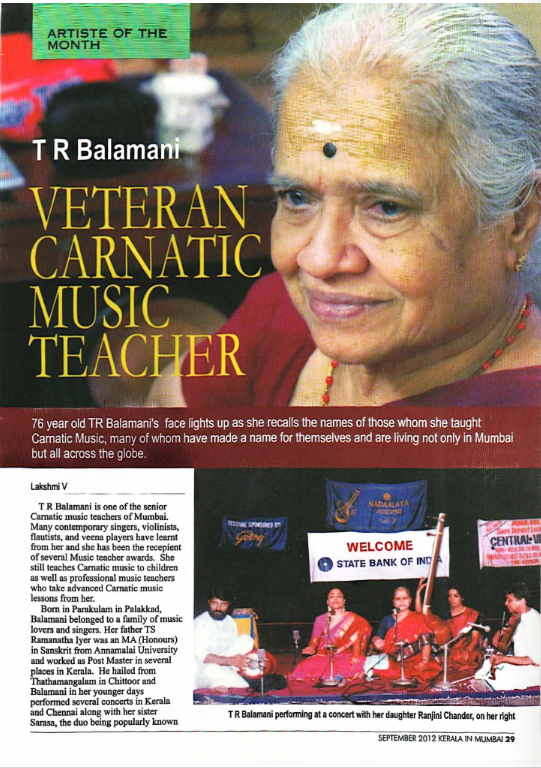
In this edition of Mumbaiyile Malayali Prathibhakal, we are proud to present T. R. Balamani, a veteran Carnatic music teacher and one of the senior-most teachers of Carnatic music in Mumbai. She was featured as the “Artiste of the Month” in the September 2012 issue of Kerala in Mumbai. At the age of 76, Balamani looked back with pride on a lifetime dedicated to music and recalled the many students she had trained, several of whom went on to establish themselves as accomplished musicians in Mumbai and across the world.
Born in Parurkulam, Palakkad, Balamani grew up in a family of music lovers and singers. Her father, T. S. Ramnatha Iyer, was an M.A. in Sanskrit from Annamalai University and worked as a Post Master in several places in Kerala. Her mother was the renowned Late Painayankiyil Ammal. Balamani began learning Carnatic music at the age of nine, and by the age of ten she had already started performing on stage with her sister Samsa, with the duo becoming popularly known as the Thathamangalam Sisters.
Her musical training was shaped by several distinguished teachers. She initially learned from Narayanan Bhagavathar of Thrippunithura and later studied under T. K. R. Govinda Rao, who became an important mentor in her musical journey. She also studied under T. K. Rangappan Menon and pursued advanced studies in music under the guidance of Musiri Subramania Iyer, including the National Scholarship programme. Her principal instrument of study was veena, and her academic training also included MA in Veena and further study of music theory.
After moving to Mumbai, Balamani continued to develop her career as a performer and teacher. She has performed numerous Carnatic concerts and has been honoured with several awards recognising her contribution to music education. Among the recognitions mentioned in the article are the Fine Arts Society’s Guru Vandana – Carnatic Music Teacher Extraordinary Award, the SMA Shakti Award, the Dr. M. S. Subbulakshmi Best Music Teacher Award, the Nadabrahmam Lifetime Achievement Award and Citation. She was also associated with teaching and musical activities at institutions in Mumbai, including Bharatiya Fine Arts and Music.
Her contribution to Carnatic music has extended well beyond her own performances. Balamani has trained generations of students, many of whom have gone on to become singers, musicians and teachers. The article mentions students including Shankar Mahadevan, Prasanna Warrier, Lakshmi Rajagopal, Vasumathi Badrinathan, Gopalakrishnan, Vidya Balasubramaniam, Sujatha Sanjay, Reena Raghur of Roopkumar Rathod, Shonali Rathode, Prasanna Venkataraman, Sanjeev Chimmalgi and several others. A photograph on page 2 also features Balamani with her daughter, grandchildren and her student Shankar Mahadevan.
Balamani’s dedication to music has also been reflected in her involvement with major musical events and institutions. She presented a lecture at the Cleveland Thyagaraja Festival, where she received the Bharatiya Fine Arts Acharya Ratnakar Award for service to Indian classical arts. The Chennai Academy of Music and Fine Arts also bestowed the Sangeetha Kala Acharya Award on her. These honours recognise a career that has combined performance, teaching and the preservation of India’s classical musical traditions.
Beyond her professional life, Balamani’s family has also remained closely connected to music. Her daughter Ranjini Chander, who lives in the United States, learned Carnatic music from her mother and Hindustani music from Geetha Chanda and Thathachari. Balamani’s husband was N. C. Mani, and the article also records the close relationship she maintained with her students and the wider musical community.
For aspiring singers, Balamani’s advice remains simple and rooted in discipline: learn sincerely, practise regularly, attend Carnatic concerts, listen to different types of music, and learn from one teacher for a sufficient period to understand the nuances of classical music. Her own life reflects these very values—a lifelong journey of learning, performing and passing the richness of Carnatic music on to future generations.
We hope this regular feature will continue to celebrate the remarkable Malayalees who have contributed to Mumbai’s cultural landscape. T. R. Balamani’s story is a testament to the enduring power of a dedicated teacher, whose greatest legacy lies not only in her own musical journey, but in the generations of students she has inspired and guided.
http://keralainmumbai.com/wp-content/uploads/2026/09/Image-to-PDF-20260916-17.57.16.pdf