

Harikumar Menon
Vice President
Democratic Social Justice Party (DSJP)
State of Keralam

There has been considerable discussion recently about the new charge on certain UPI transactions. In particular, there appears to be some confusion about whether the charge is 4% or 0.4%, and whether it is a tax.
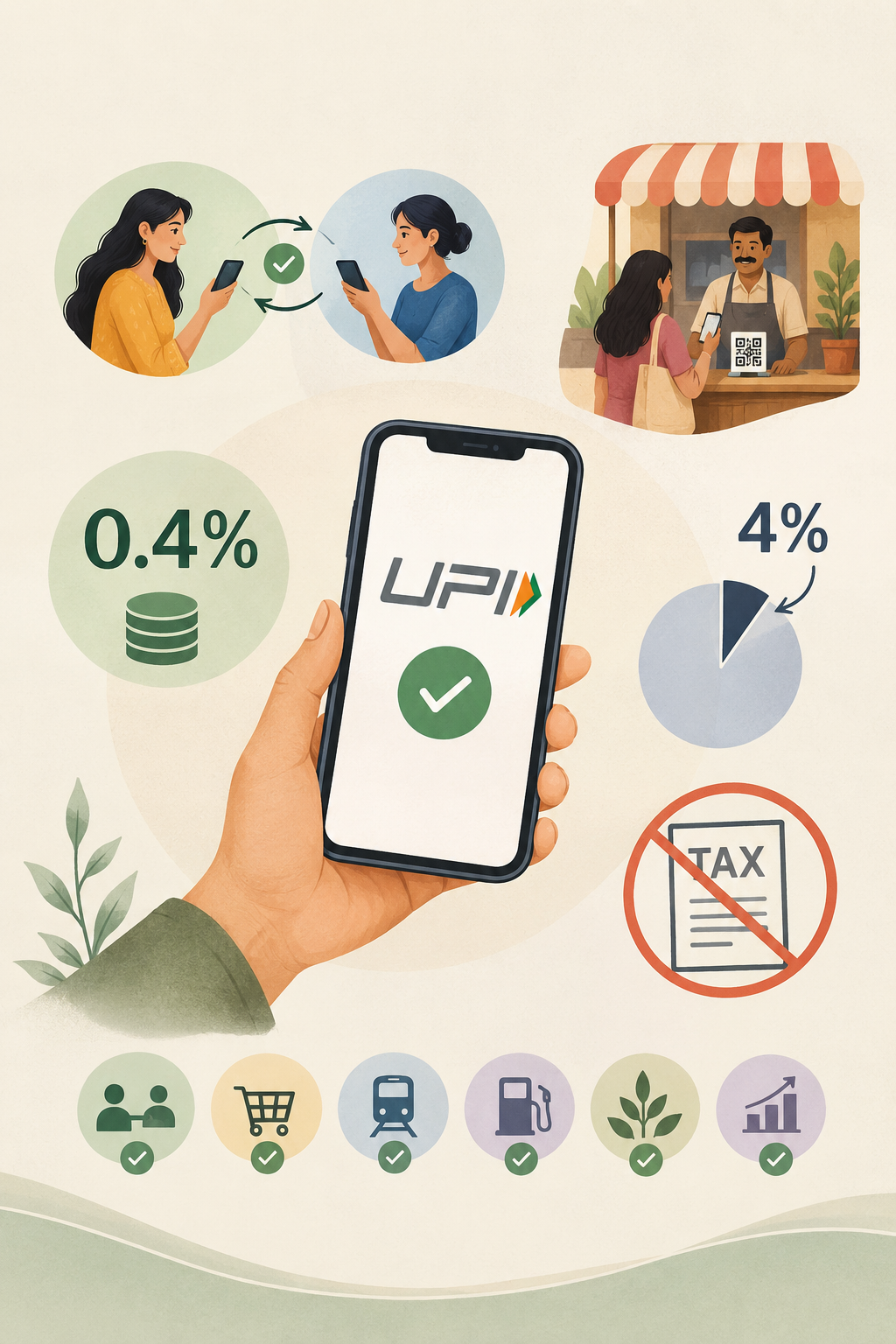
The facts are quite clear: the new rate is 0.4%, not 4%, and it is not a tax. It is called the Merchant Discount Rate (MDR) and applies only to specified Person-to-Merchant (P2M) UPI transactions above ₹2,000.
What exactly is 0.4%?
MDR is a fee associated with processing a digital payment. Under the new UPI framework, a 0.4% MDR will apply to specified merchant transactions above ₹2,000.
For example:
- ₹5,000 eligible merchant payment → MDR of ₹20
- ₹10,000 eligible merchant payment → MDR of ₹40
- ₹50,000 eligible merchant payment → MDR of ₹200
For transactions of ₹75,000 and above, the MDR is capped at ₹300 per transaction.
Importantly, this is not a 0.4% tax imposed on the customer. MDR is a charge within the payment ecosystem, and merchants should not pass this charge on to customers.
Then where did the figure 4% come from?
This is where much of the confusion appears to have originated.
The Government says that MDR will apply to only about 4% of merchant transactions. Consequently, approximately 96% of merchant transactions will remain unaffected.
Therefore:
0.4% = the MDR rate for specified transactions.
4% = approximately the proportion of merchant transactions to which MDR will apply.
The two figures are completely different and should not be confused.
Will ordinary UPI users have to pay?
For ordinary users, the important point is that Person-to-Person (P2P) UPI transactions remain completely free, irrespective of the amount transferred.
Merchant payments of up to ₹2,000 will also remain free of MDR.
Thus, the new framework is primarily directed at a limited category of higher-value merchant transactions, rather than ordinary person-to-person transfers.
How does a UPI payment actually work?
UPI stands for Unified Payments Interface. It enables a person to transfer money directly from a bank account to another bank account, generally within seconds.
The process is simple:
- Open a UPI app
The user opens a UPI-enabled application and selects the bank account from which the payment is to be made. - Identify the recipient
Payment can be initiated by scanning a QR code, entering a UPI ID, selecting a saved beneficiary or using another supported UPI method. - Enter the amount
The customer enters the amount and checks the recipient’s details. - Enter the UPI PIN
The customer enters the UPI PIN to authorise the transaction. - Processing through the UPI ecosystem
The UPI infrastructure facilitates communication between the payer’s bank and the recipient’s bank and enables the funds to be transferred. - Confirmation
Once the transaction is successfully completed, the payer receives confirmation and the merchant or recipient receives the money in the designated bank account.
The entire process normally takes only a few seconds.
Why is MDR being introduced?
UPI has grown into one of the world’s largest real-time digital payment systems. It processes billions of transactions every month and requires substantial investment in technology, cybersecurity, infrastructure, fraud prevention and customer service.
The MDR collected under the new framework will remain within the payment ecosystem and help support its continued operation and expansion.
What about essential services?
There are also special provisions for certain essential and thin-margin sectors.
For transactions above ₹2,000 in sectors including railways, telecommunications, insurance, fuel and agricultural inputs, a flat MDR of ₹5 per transaction will apply rather than the standard 0.4% rate. Capital-market transactions have a separate lower MDR structure.
What does this mean for the common man?
For most people, the practical effect should be limited.
If you send ₹20,000 to a family member through UPI, that is a P2P transaction and remains free.
If you buy something from a merchant for ₹1,500 through UPI, it remains within the ₹2,000 threshold and there is no MDR.
If you make an eligible ₹10,000 merchant payment, the applicable MDR is 0.4%, or ₹40. However, this is a merchant-side payment-system charge and should not be separately recovered from the customer.
The simple conclusion
The new UPI framework should therefore be understood correctly.
It is not a 4% tax.
It is not even a 0.4% tax on the customer.
It is a 0.4% Merchant Discount Rate on specified UPI merchant transactions above ₹2,000, subject to the applicable exemptions and caps.
At the same time, P2P UPI transactions remain free, merchant payments up to ₹2,000 remain free, and approximately 96% of merchant transactions will remain unaffected.
UPI has become an essential part of India’s digital economy. The new framework represents a change in how part of this vast payment infrastructure is financed, while retaining free access for ordinary person-to-person payments and protecting small-value transactions.
The key message is therefore simple:
0.4% is the MDR rate.
4% is approximately the share of merchant transactions affected.
Neither figure represents a 4% tax on UPI payments.