
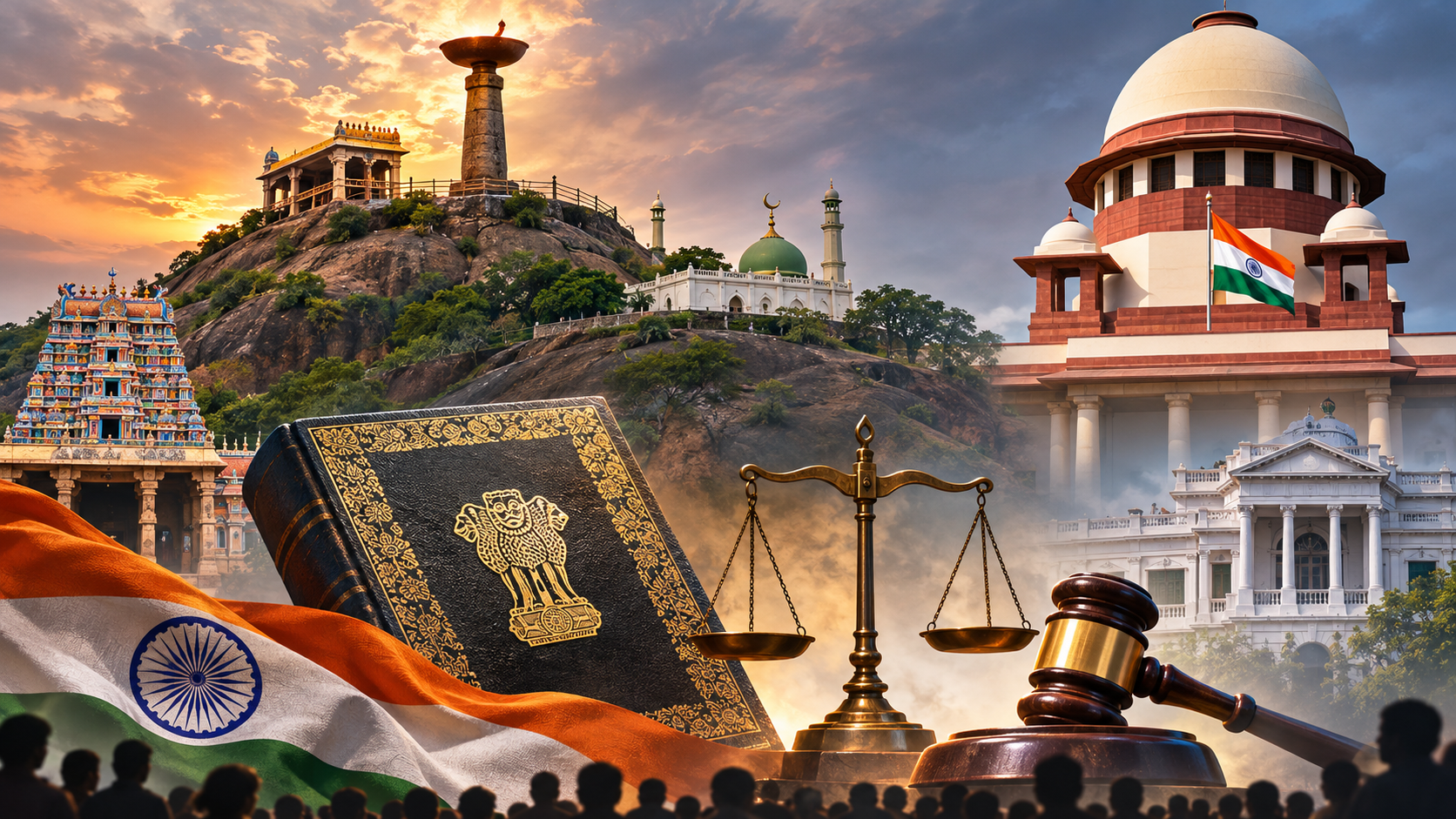
The Thiruparankundram Deepathoon controversy exposes the dangerous face of political appeasement and selective constitutional morality.
What happened at Thiruparankundram in Madurai on November 24, 2026, is deeply disturbing. It is not simply a dispute over lighting a traditional Hindu blamp. It is a serious challenge to the rule of law, the authority of the Supreme Court, religious freedom and the very principles of constitutional governance.
The Supreme Court had permitted the lighting of the Karthigai Deepam lamp at the Deepathoon, a stone pillar atop Thiruparankundram Hill, as a one-time arrangement with specific safeguards. The Court had clearly stipulated that only an authorised team would be permitted to perform the ceremony, without disturbing the nearby dargah or mosque.
Yet the lamp was not lit at the designated Deepathoon. Instead, the Vijay-led Tamil Nadu government allowed the ceremony to take place at the customary Uchi Pillaiyar Mandapam.
The Madurai District Collector subsequently apologised before the Supreme Court, while devotees alleged deliberate circumvention of the Court’s direction. The Supreme Court has agreed to hear the plea seeking implementation of its order and a separate contempt petition.
This raises an extremely serious question: Does a state government have the liberty to disregard a direction of the Supreme Court simply because it finds compliance politically inconvenient?
A government cannot be bigger than the Supreme Court
The Constitution does not give governments the freedom to selectively obey judicial orders. If the government disagreed with the Supreme Court’s decision, it had every legal right to seek a review or appropriate relief. Indeed, the state had approached the Supreme Court seeking a review.
But a review petition does not give the government a licence to act as though the original direction does not exist.
The Supreme Court is the highest judicial authority in the country. Its directions cannot be reduced to suggestions that governments may accept or reject according to their political calculations.
The Vijay government must explain why the specific arrangement permitted by the Supreme Court was not implemented.
A government that cannot respect the authority of the Supreme Court has no moral authority to lecture others on constitutional values.
Is Hindu religious freedom negotiable?
The lighting of a traditional lamp is an expression of faith and devotion. For millions of Hindus, Karthigai Deepam is a deeply significant religious observance.
The issue here is not about denying anyone else’s religious rights. The Supreme Court itself had imposed safeguards to ensure that the enjoyment of the nearby dargah and mosque would not be disturbed.
Then why was it so difficult for the state administration to implement a carefully restricted arrangement?
Religious harmony must be built on mutual respect and equal treatment. It cannot be achieved by repeatedly asking one community to surrender its legitimate religious aspirations.
Secularism does not mean that Hindu religious practices should be treated as a political inconvenience. Nor does it mean that the government should yield to pressure whenever a Hindu religious observance becomes controversial.
True secularism is equal respect for all religions, not selective sensitivity towards some and indifference towards others.
Vijay must answer the people
Vijay has entered public life with considerable expectations and has assumed the responsibility of governing a state with a rich cultural and religious heritage.
But leadership is not merely about winning elections. It is about demonstrating the courage to uphold the law, even when doing so involves political risks.
If the government believed that there were genuine security concerns, it was its responsibility to make appropriate arrangements within the framework laid down by the Supreme Court.
The Court had already provided for a restricted team, security arrangements and protection of the dargah and mosque.
What greater opportunity did the government need to demonstrate that religious harmony and judicial compliance could go hand in hand ?
Instead, the episode has created the impression that political considerations have taken precedence over constitutional responsibility.
Vijay owes the people of Tamil Nadu an explanation.
Rahul Gandhi: Where is the Constitution now?
Perhaps the most glaring political contradiction is the silence of Rahul Gandhi.
He has made the Constitution a central symbol of his political campaign. He is frequently seen carrying a copy of the Constitution and accusing his political opponents of undermining constitutional institutions.
But the Constitution is not a political accessory. It is not a prop to be displayed at public meetings. It is a solemn commitment that must be defended consistently, irrespective of political convenience.
Where is Rahul Gandhi’s unequivocal criticism of the failure to implement the Supreme Court’s direction?
Where is his demand that the Vijay government respect the authority of the judiciary?
Where is the same passion for constitutional values when a government associated with his political alliance is confronted with such serious questions?
If Rahul Gandhi genuinely believes in the Constitution, he must have the courage to question his political allies as well.
The Constitution cannot be held high in one hand while constitutional accountability is conveniently ignored with the other.
A leader who demands accountability from his opponents must be equally prepared to demand accountability from his allies.
What about the INDI Alliance ?
The INDI Alliance has repeatedly projected itself as the defender of democracy, secularism and constitutional institutions.
But principles are meaningful only when they are applied consistently.
The Congress and its political partners cannot claim to defend constitutional democracy nationally while avoiding difficult questions about the conduct of governments with which they are politically associated.
An alliance that remains silent when a Supreme Court direction is allegedly circumvented must answer whether its commitment to constitutional values is genuine or merely electoral rhetoric.
Democracy cannot function on selective outrage.
If the BJP or an NDA government were involved in a similar controversy, would Rahul Gandhi and the INDI Alliance have remained silent?
We know how loudly they would have protested.
Then why the apparent reluctance now?
Constitutional morality cannot have one standard for political opponents and another for political allies.
This is bigger than a lamp
Let us be clear. This controversy is not about establishing the superiority of one religion over another. It is about the right of citizens to practise their faith within the framework of the law, and the obligation of governments to respect judicial authority.
The Supreme Court’s interim permission was limited to one occasion and did not establish a final customary or religious right at Deepathoon. That distinction must be respected. But the limited nature of the permission does not make its implementation optional.
The real danger is the precedent that political convenience can take precedence over judicial directions.
Today it may be a religious ceremony. Tomorrow it could be another fundamental issue affecting the rights of citizens.
India’s constitutional democracy cannot afford such an approach.
A final question to Rahul Gandhi and Vijay
Rahul Gandhi, you frequently hold the Constitution in your hand and speak about saving it.
Vijay, you have been entrusted with the responsibility of governing Tamil Nadu.
The people of India are entitled to ask both of you:
Is the Constitution merely a political slogan, or is it a binding commitment?
Will you respect the Supreme Court even when its directions are politically inconvenient?
Will you defend the religious freedoms of citizens without discrimination?
Will you uphold the rule of law even when doing so may upset your political supporters or alliance partners?
A lamp can be prevented from being lit at a particular location. But the questions raised by this episode cannot be extinguished so easily.
The Supreme Court must be respected. The Constitution must be honoured. Religious freedom must be protected. And political leaders must be held accountable.
India does not need leaders who merely carry the Constitution. It needs leaders who have the courage to live by it.
A Constitution displayed is not necessarily a Constitution defended.
Jai Hind
🇮🇳 Vande Matharam 🇮🇳
Harikumar Menon
Vice President
Democratic Social Justice Party (DSJP)